Salt & Smoke
One fire on an Oregon bluff, sunset to moonrise. Tonight's menu is written in its smoke.
Laarpi Studio
A hand-wound calibre you can wind, take apart under a loupe and watch start again.
A concept launch page for a fictional watchmaker's first calibre. The movement runs live at your own time, comes apart in service order, shows its finishing under macro lenses and starts again when you wind it.
Meridian M-01 is a launch and reservation page for the first hand-wound calibre from Meridian, a one-bench watchmaker making eighteen watches in 2027. The page is the bench. The movement runs on it at your own time, and you wind it, take it apart, look at its finishing under a loupe and watch it start again.
It is a concept site, made by the Laarpi team with Laarpi's library and process. The watchmaker and the watch are invented.
The audience reads movements before dials: collectors of independent watchmaking, people saving for one serious mechanical watch, and watchmakers who will zoom in to check the bevels. The brief set three goals: reserve the eighteen numbered pieces, make the finishing legible to someone who has never held a loupe, and prove the calibre is a coherent machine, with parts, counts, gear ratios and a specification.
The metaphor is a watchmaker's bench: paper under north light, a loupe for a cursor, a crown you turn to store energy, and a parts sheet where the calibre lies in the order it is serviced.
The brief ruled out the usual luxury-watch look: black backgrounds, gold gradients, lens flares, invented press quotes and collector logos, stock watch models, and smooth fade-ups on everything. It also ruled out colour in the interface. The page is strictly paper, graphite and pencil greys, so every colour you see comes from light in the render: the warm German silver, the gold of the wheels, the blue of heat-blued screws and the red of the rubies.
The interface moves in whole beats of the escapement, in eighth-of-a-second steps. Smooth motion is kept for physics only: the balance swing and parts gliding as you scroll.
The M-01 is a procedural model at true millimetre scale. The plate and bridges are traced from drafted outlines, with 45-degree bevels. The going train uses real ratios (96/12, 80/10, 75/10, 112/7), with a 15-tooth escape wheel, a pallet fork and a balance carrying eight gold screws and a breathing overcoil. The wheels are generated from their tooth counts.
The finishing is computed per pixel rather than painted: perlage, Côtes de Genève with the arcs of the polishing peg, mirror bevels, black polish, snailing, sunburst and thin-film bluing. Tool marks appear only under magnification. The movement is lit by a photographer's set built in the shader, with an overhead diffuser, softboxes, strips and black flags, and a CC0 Poly Haven studio HDRI mixed in for the irregularity of a real room.
Noto Serif Display, at hairline weights and its condensed width, reads like an engraver's line. It carries three typographic peaks: M-01, the beat count when the watch starts, and 18. Epilogue sets the reading, the labels and the tabular figures.
The how to build a 3D website guide walks through the same choices for any object. The 3D website examples and product website examples show it beside our other concept sites, and the product launch page use case covers what a launch page needs to sell.
Measured on 6 October 2026, cold, with an empty cache, on our phone profile: slow 4G (1.6 Mbps down, 150 ms round trip), CPU slowed four times, a 390 × 844 screen.
| What | Measured |
|---|---|
| First paint, with the "Winding" loader | 0.9 s |
| First frame with the movement fully drawn | 11.5 s |
| Transferred | 1,712 KB, 21 requests, one origin |
On a fast connection without the CPU slowdown, the movement was drawn at about 1.0 s. The phone time is long because the movement needs 31 shader programs, down from 43 after a loading pass on the same day, and the slowed CPU waits on each one. The loader shows real progress the whole time, so the screen is never blank. Rendering resolution is capped (2× on desktop, 1.5× on touch screens), the canvas sleeps when nothing 3D is on screen, and everything is released when you leave. Fast websites with 3D explains the trade-offs.
With reduced motion on, there is no smooth scrolling. You get three still movements in their stages, a still flat lay in the parts sheet, and static lenses. Nothing flashes. The Wind control is a real button that works with Enter, Space and the up and right arrow keys. If WebGL is not available, a still frame of the site's own render stands in. See accessible motion for the reasoning.
A concept site made by the Laarpi team with Laarpi's library and process. It was not produced end to end by SI, Laarpi's website agent. Sites SI builds on its own carry a "Built by SI" label with their build time and cost.
| Piece | By | Licence |
|---|---|---|
| Studio Small 03 (HDRI) | Greg Zaal, Poly Haven | CC0 1.0 |
| Metal 049 A | ambientCG | CC0 1.0 |
| Noto Serif Display | SIL OFL 1.1 | |
| Epilogue | Etcetera Type Co | SIL OFL 1.1 |
| three.js 0.186.1 | three.js authors | MIT |
| Lenis 1.3.26 | darkroom.engineering | MIT |
The shaders, the scene code and the loader were written for this site.
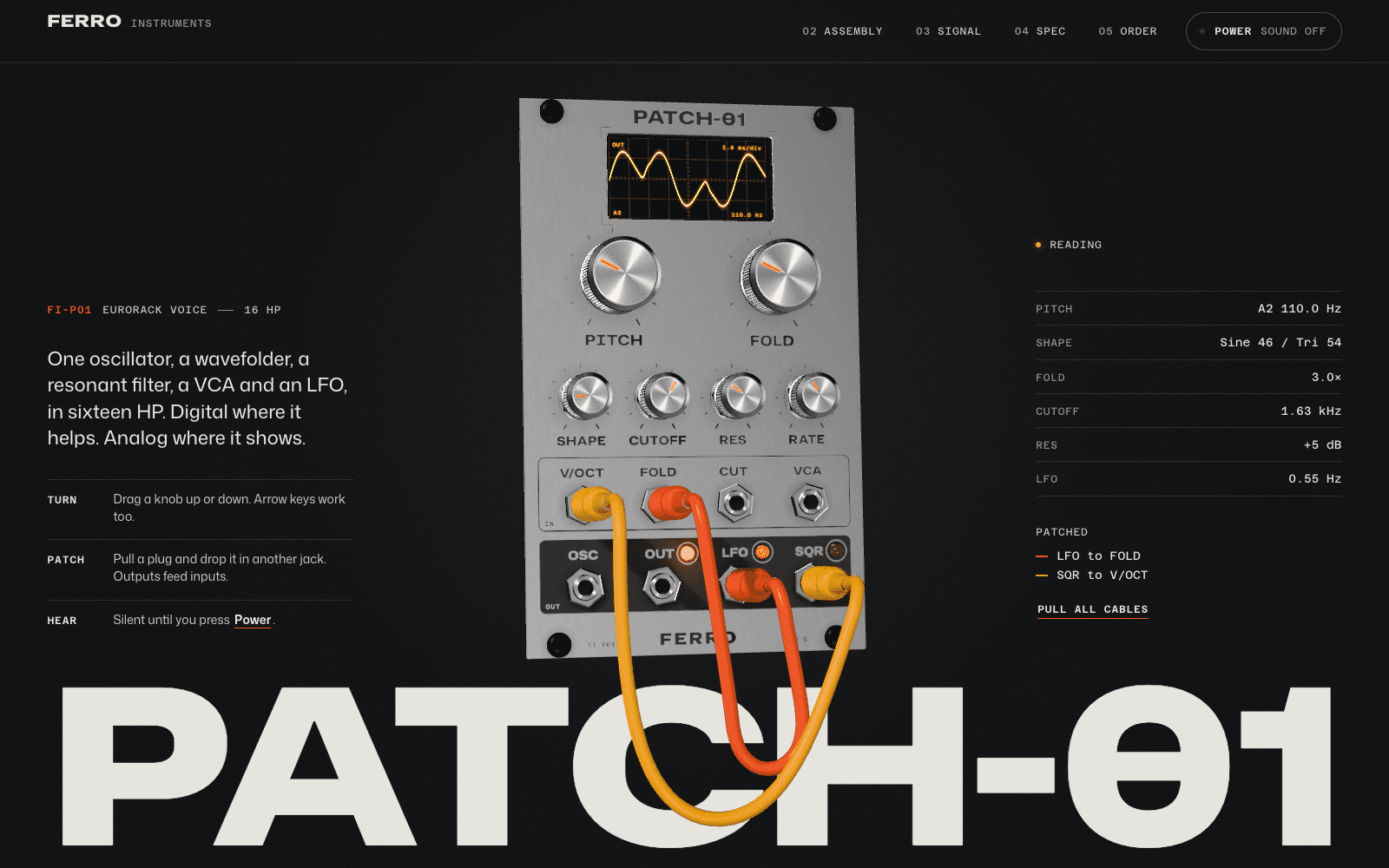
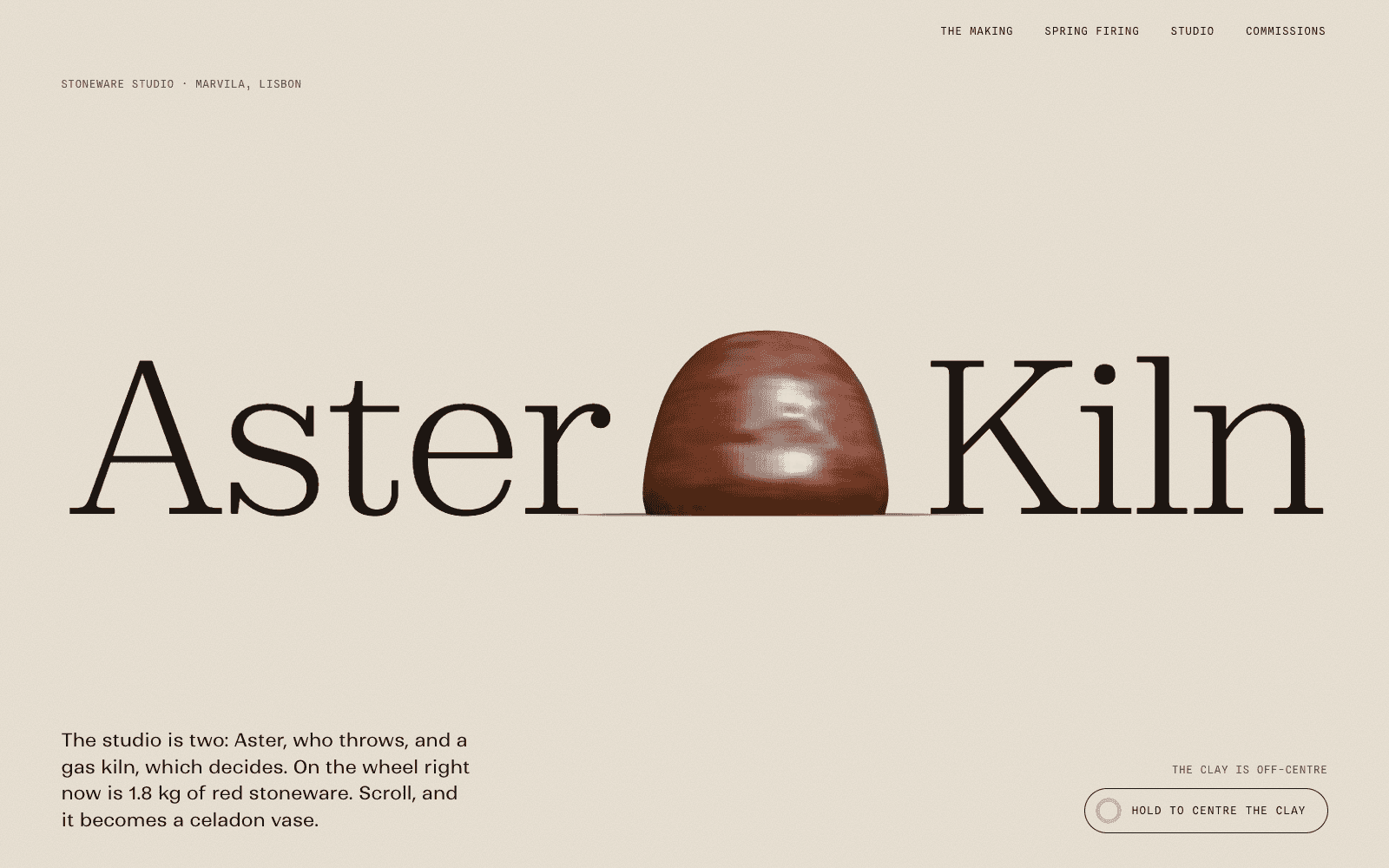
For two more objects you can handle, see PATCH-01, a synth module you can play, and Aster & Kiln, a vase you watch being thrown and fired. To start your own product page from this one, remix it.
No. Meridian and the M-01 are fictional, made up for this concept site by the Laarpi team. The movement is drawn to be mechanically coherent, with real gear ratios, but it has never been made in metal.
No. The reservation button uses Laarpi's Polar checkout module, but no store is connected to this concept, so the button is disabled and nothing is sold. On your own site the same button opens a real checkout once you connect your Polar account.
No. The plate, bridges, wheels, balance and screws are generated in code from drafted outlines and tooth counts, and every finish is computed per pixel. The only downloaded assets are one studio lighting file and one small metal texture, both CC0.
No. It was made by the Laarpi team with Laarpi's library and process, with people steering every step. Sites that SI builds end to end are labelled "Built by SI" and show their build time and cost.
The movement needs dozens of shader programs and a lighting file before it can be drawn. On our slow phone profile the first fully drawn frame came at 11.5 s on 6 October 2026, with the loader showing real progress from 0.9 s. On a fast connection without the CPU slowdown it took about 1.0 s.
Yes. Remix copies the site's code and plan into a project of your own, then you tell the agent what to change. Your product needs its real specification and photographs or measurements, which you provide.
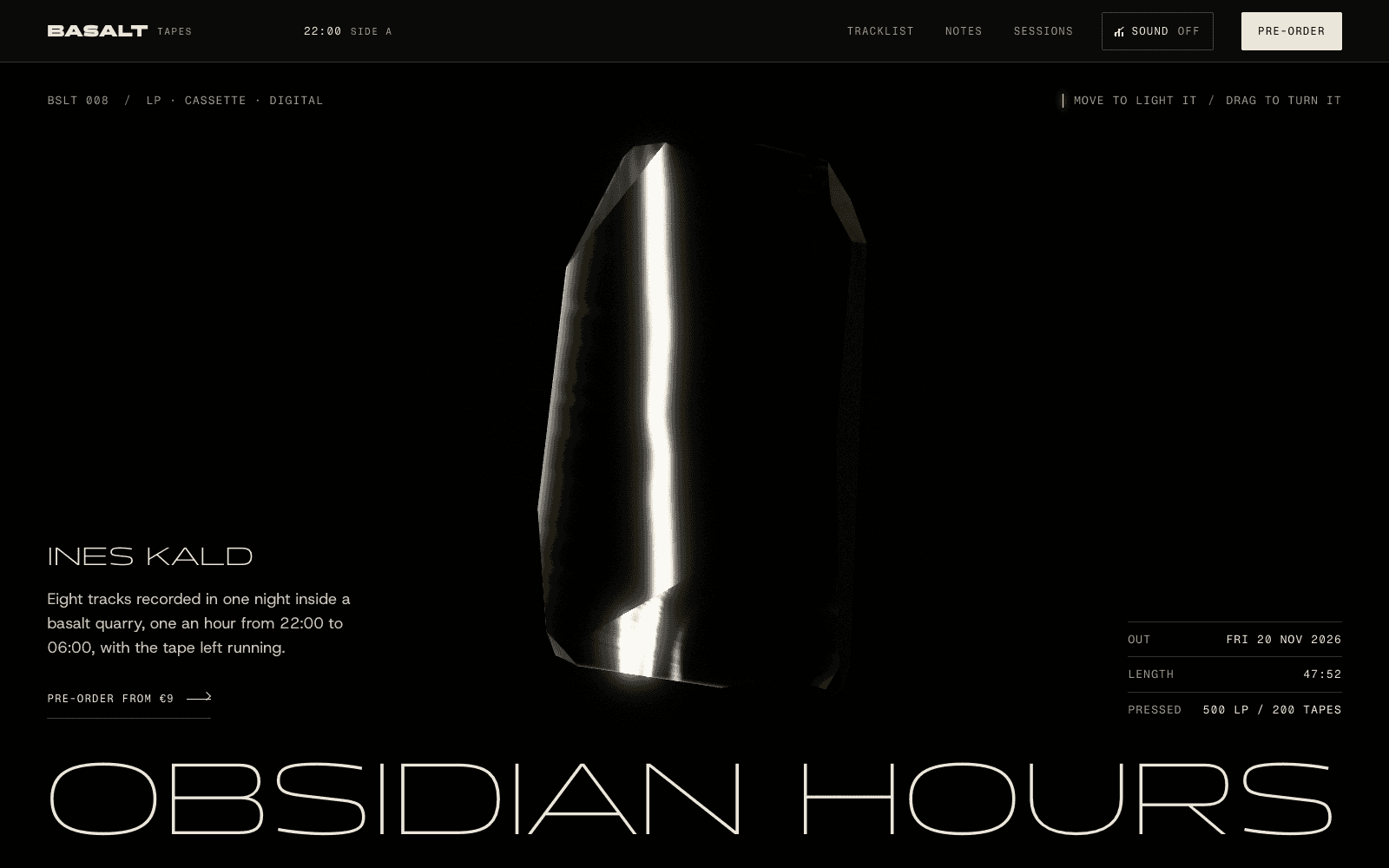
One fire on an Oregon bluff, sunset to moonrise. Tonight's menu is written in its smoke.
Laarpi Studio
A Eurorack voice you can play in the page: turn it, patch it, take it apart, hear it.
Laarpi Studio
A pressed gazania that stands up and blooms only while you hold the cursor still.
Laarpi Studio
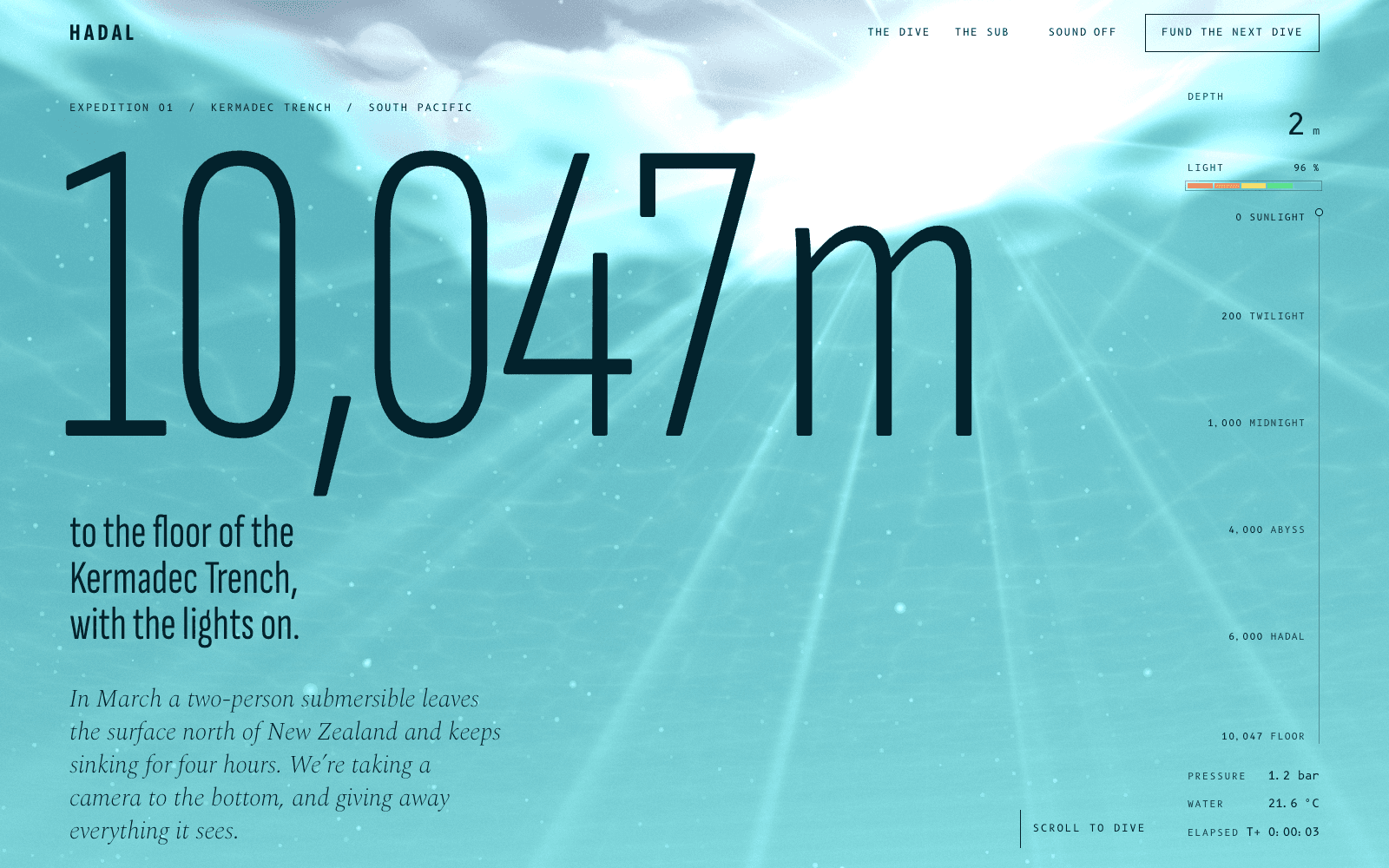
Scroll to the floor of the Kermadec Trench. Below 1,000 m your cursor is the lamp.
Laarpi Studio
Remix this site, or describe a new one. It asks what matters, then designs and builds it from scratch.