Laarpi vs Webflow
Webflow is a visual development platform with a CMS, ecommerce and GSAP-powered interactions, built for teams who build by hand. Laarpi is a coding agent that designs each site from scratch, with real-time 3D and a backend on your accounts.
Short answer. Choose Webflow if you, or someone on your team, wants to build by hand with precise control, run a large CMS, or sell physical products. Choose Laarpi if you want a site designed from scratch around your idea, with real-time 3D and motion that carry the story, built and checked by a coding agent, and shipped with sign-in, data and payments on your own accounts.
Webflow is a professional tool for building websites visually. Laarpi is a coding agent that does the building and the designing, and takes direction from you.
| Compared | Laarpi | Webflow |
|---|---|---|
| What it is | A coding agent that designs and builds each site from your description | A visual development platform with CMS, ecommerce, hosting and AI tools |
| How you work | Describe the site, answer a few questions, steer in chat or by clicking any element | Build visually in the Designer, with an AI site builder and AI assistant to help |
| Skill you need | None; the code is readable in the studio if you want it | Comfort with web layout concepts (boxes, classes, breakpoints) to get the most from it |
| Motion | Motion written for each concept, with a still version for reduced motion | Interactions with GSAP: a visual timeline editor, plus Classic Interactions |
| Real-time 3D | Built in: three.js scenes written for the story, lit and shaded | Through custom code, code components or embeds |
| The code | Plain HTML, CSS and JavaScript you can read and edit in the studio; download is planned | Code export on paid Workspace plans (Core and up) |
| Sign-in, data, payments | Supabase and Polar connected on your own accounts | Built-in CMS; ecommerce on separate Ecommerce plans |
| Hosting and domains | A laarpi.site address on publish; custom domains from Pro | Webflow hosting; a custom domain on paid Site plans |
| Pricing model | Per account; credits metered by what each agent turn really costs | A Site plan per site, plus an optional Workspace plan for seats and features |
| Paid plans from | $25 a month, or $20 a month billed yearly | $15 a month per site, billed yearly |
Facts about Webflow come from its own pricing and product pages, checked in October 2026. Prices and plan names change, so treat them as a snapshot and check the sources on this page before you decide.
What Webflow is
Webflow is a visual development platform. You build in the Designer, which works with the same concepts the web does: boxes, classes, layouts and breakpoints. Around it sit a CMS, hosting, ecommerce plans, localization, and a growing set of AI tools. Webflow's AI site builder generates a site with a scalable design system from a prompt, and the Webflow AI assistant works inside the platform to help you build, write and manage content. Webflow also offers an MCP server, so you can connect tools like Claude and Cursor to a Webflow site.
Webflow rewards skill. In the hands of someone who understands layout and CSS, it produces clean, specific work without writing code.
What Laarpi is
Laarpi is a coding agent for websites. You describe the site, and it asks only the questions that change the result, as cards in the chat with concrete options such as palette swatches and font specimens. Then it writes the plan: the concept, the palette, the type, the sections and the motion. You can edit any line.
It builds the site as real code, live, and then checks its own work: screenshots at desktop and phone sizes, a layout check at six widths, and a separate art-director review that scores the site on eight things, from concept clarity to reduced motion. On a Finish, it revises at least twice. You steer in plain words or by clicking any part of the preview. When you publish, it goes to a laarpi.site address or your domain, with Supabase and Polar on your own accounts. How it works has the whole sequence.
Who does the designing
On Webflow, you do. The AI site builder gives you a starting site and the assistant speeds up the work, but the craft happens in the Designer, element by element. For a studio with Webflow developers, that is exactly right: the client gets a precise, maintainable site.
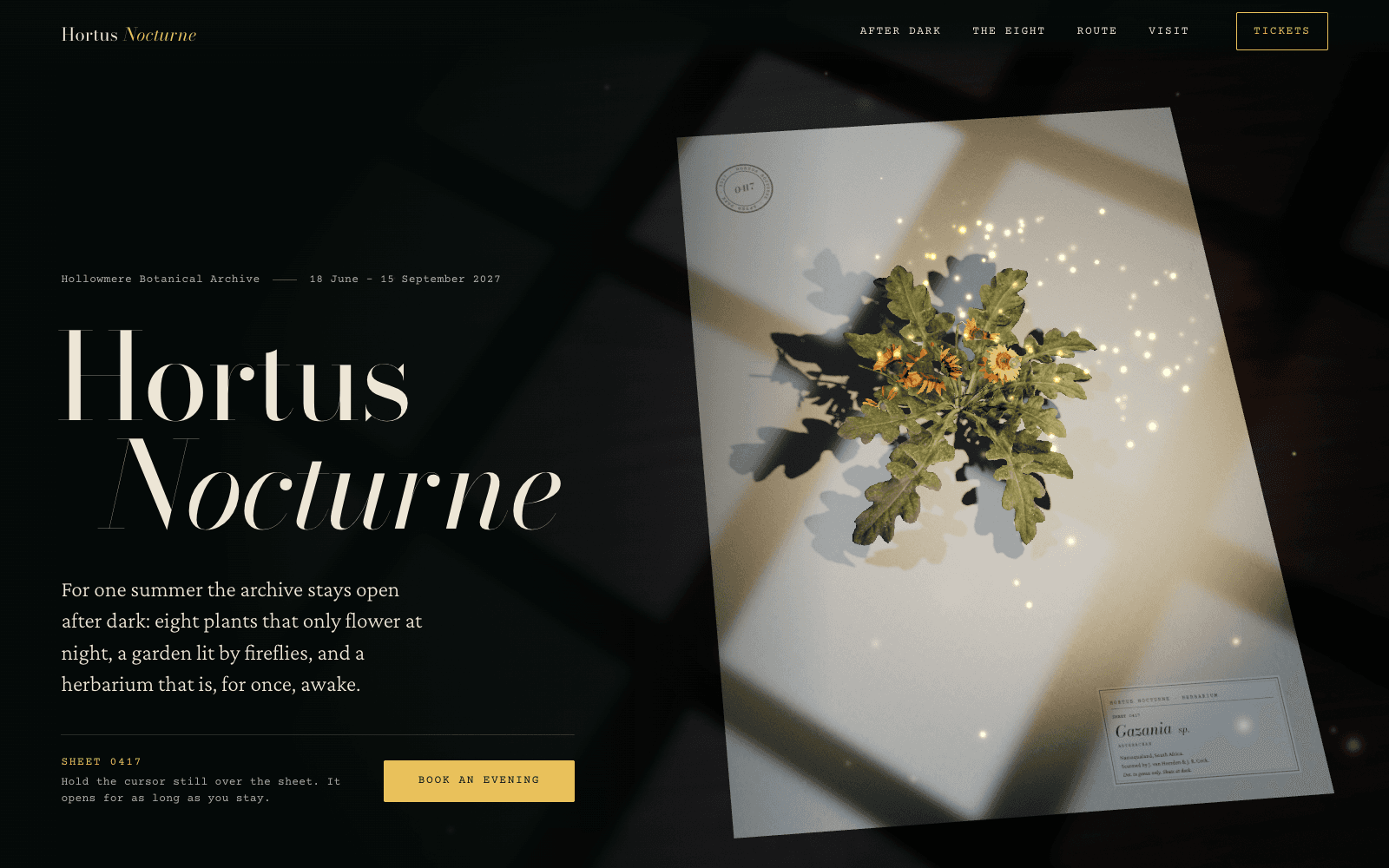
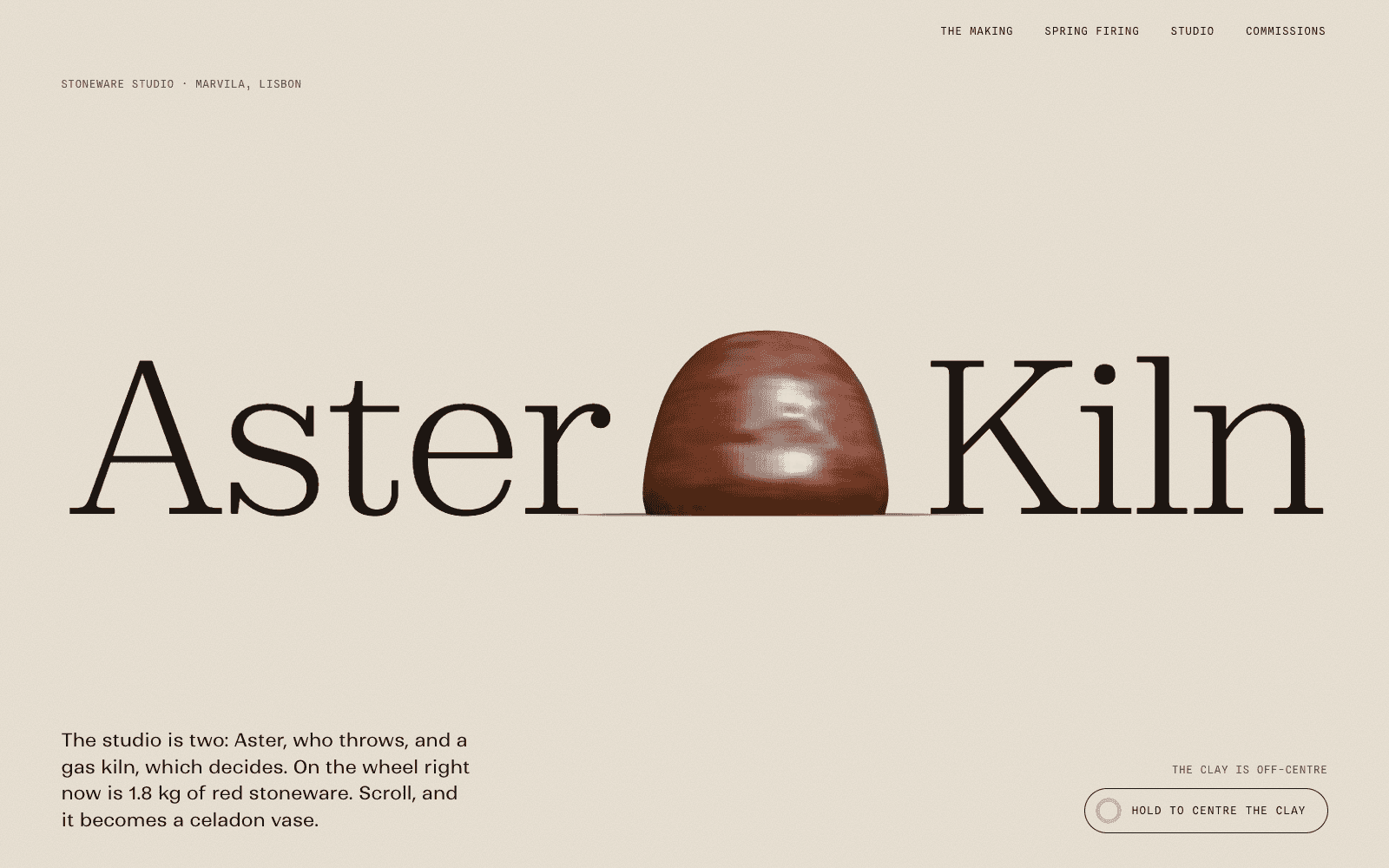
On Laarpi, the agent designs first and you direct. It develops more than one concept privately, keeps the strongest, chooses type for the idea rather than out of habit, and builds every section around one focal point on a real grid. Then you push it: heavier, quieter, more air, a different face, that image bigger. Only the part you point at changes.

An electronic music festival in a disused power station, printed in ink you can stir. The fluid is the poster.
Motion and real-time 3D
Webflow's Interactions with GSAP is a capable motion tool: you build reusable animations on a horizontal timeline, visually, and Classic Interactions remain available. If your idea is mostly scroll-linked reveals, parallax and timeline animation, Webflow can do it well in skilled hands.
Real-time 3D is different. On Webflow it comes from custom code, code components or embeds, which means someone has to write or source the scene and tune it.
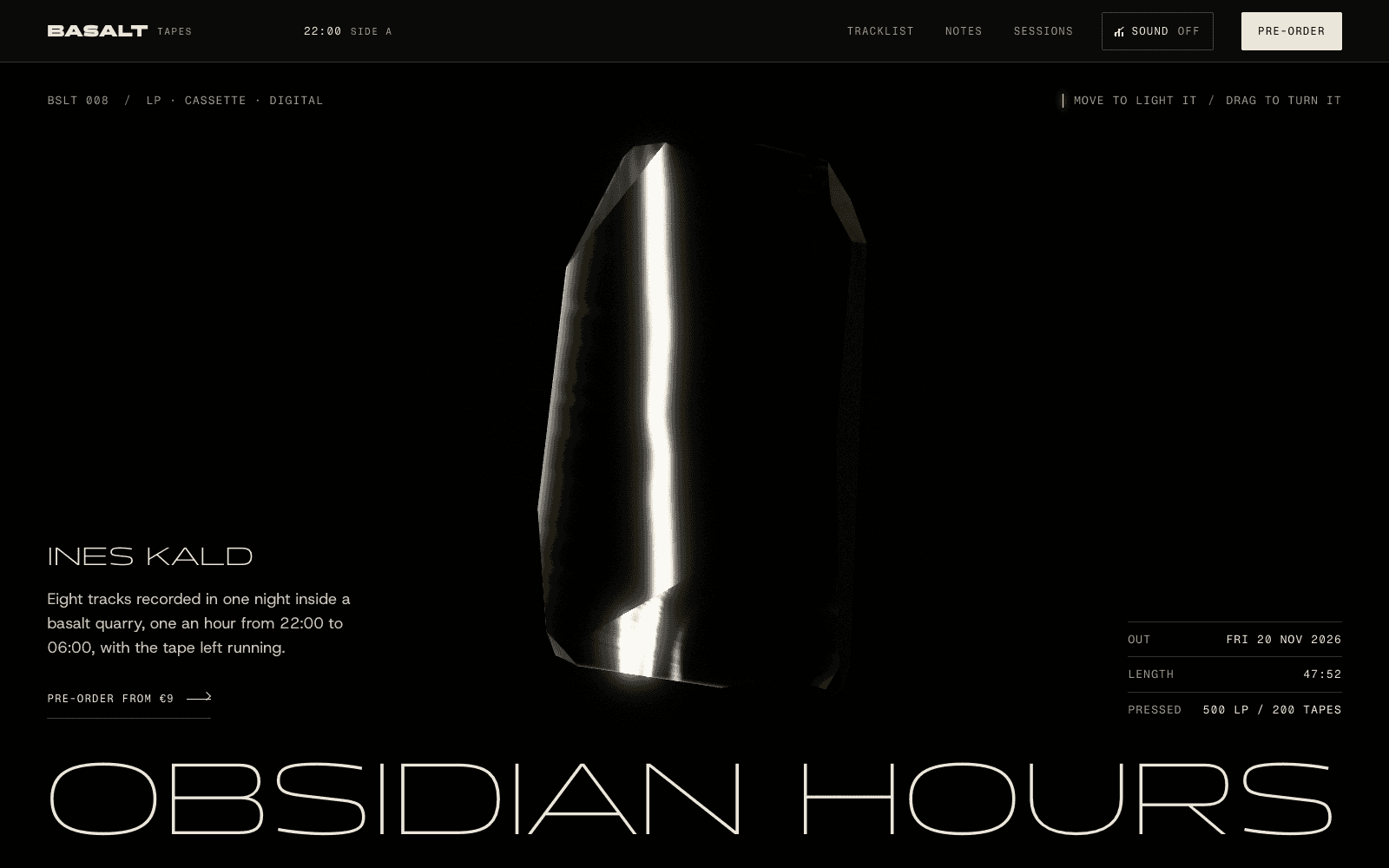
On Laarpi, 3D is part of the design when the idea calls for it, and left out when it doesn't. The scene is three.js written for that concept: lit with open-source HDR environments, shaded with real materials, answering scroll and cursor. Real objects use real open-source models, credited in the site. Rendering is capped on phones and paused off screen, and every site ships a composed still version for visitors who turn motion off.

A descent to the floor of the Kermadec Trench. Below 1,000 metres your cursor is the only light.
Read more in the 3D website builder and animated websites, or the long-form guide on how to build a 3D website.
Code ownership
Webflow lists code export on its paid Workspace plans, from Core upward, alongside custom code. That gives you the HTML, CSS and JavaScript of a site to host elsewhere.
A Laarpi site is plain files from the start: semantic HTML with all the copy in the page, CSS, and JavaScript modules, with libraries loaded from a pinned import map. You can read and edit the code beside the preview on every plan, every edit becomes a version. Downloading the whole site is planned and not available yet.
Backend, CMS and commerce
This is where the two tools are most different.
Webflow has a mature CMS, with collections, editors and publishing workflows on larger plans, and separate Ecommerce plans for selling products with a custom cart and checkout. The Ecommerce plans are listed at $29, $74 and $212 a month billed yearly, with item limits of 500, 5,000 and 15,000; the Standard plan carries a 2% transaction fee.
Laarpi wires a backend into the site itself, on accounts you own:
- Supabase for sign-in, profiles and the tables your site needs, with row-level security on.
- Polar for products, checkout links and a customer portal. Polar is built for software and digital goods: memberships, downloads, subscriptions and similar.
Laarpi does not have a CMS for a content team, and it is not the right tool for a store with inventory and shipping. It is the right tool for a site that needs members, a waitlist, a paid download or a subscription, wired in from the first build. See the website backend and website payments.
Pricing, side by side
Webflow separates Site plans (per site) from Workspace plans (seats, staging and features such as code export). Laarpi prices per account, and credits pay for the agent's work.
| Webflow | Laarpi | |
|---|---|---|
| Free | Starter: webflow.io domain, 2 static pages, 1 GB bandwidth, limited CMS | $0: 30 credits a month, up to 3 projects, laarpi.site address with a small “Made with Laarpi” mark |
| Entry paid plan | Basic site plan, $15 a month billed yearly: custom domain, 300 static pages, 10 GB bandwidth | Pro, $25 a month or $20 billed yearly: 250 credits, 3 custom domains; code download is planned |
| Content or bigger plan | Premium site plan, $25 a month billed yearly: CMS, from 50 GB bandwidth, code components | Max, $100 or $200 a month ($80 or $160 billed yearly): 1,200 or 2,800 credits, 10 domains |
| Teams | Workspace plans: Core $19, Growth $49 a month billed yearly; Team from $2,500 a month on an annual contract | Business, $50 a seat a month ($40 billed yearly): 600 pooled credits per seat, 25 domains |
| Selling | Ecommerce plans from $29 a month billed yearly | Polar on your account; Polar sets its own fees |
Laarpi has lower prices in India, shown automatically on the pricing page. If you would rather hand the whole thing over, Build with experts is our team building the site with Laarpi for you.
Where Webflow is the better choice
- You build sites for a living, by hand. Webflow's Designer gives a professional control over layout and CSS that a conversation never will.
- You publish a lot of content. Collections, editor roles, localization and publishing workflows are what Webflow is built around.
- You sell physical products. Webflow Ecommerce handles carts, inventory and checkout for goods. Polar, which Laarpi uses, is designed for software and digital goods.
- Your organisation needs governance. Webflow's Team and Enterprise plans add roles, permissions, activity logs and SLAs.
Where Laarpi is the better choice
- The site has to be remembered, with real-time 3D, motion and type that serve one strong idea.
- Nobody on the team builds in Webflow, and you would rather direct than learn a professional tool.
- You need members or payments wired in on accounts you own, from day one.
- You want to read and edit the source as plain files in the studio on every plan (download is planned).
Browse the community to see published sites, and remix any of them into a project of your own.
A quick way to decide
Answer these four questions honestly.
- Who will build it? If the answer is a Webflow developer, use Webflow. If the answer is nobody, or you, in between other work, Laarpi does the building.
- How often will the content change? Weekly posts, case studies and landing pages by several editors point to Webflow's CMS. A site that changes when your story changes suits Laarpi, where you steer the agent in a sentence.
- What are you selling? Physical stock points to Webflow Ecommerce. Memberships, downloads, subscriptions or a waitlist fit Laarpi with Polar.
- What should a visitor remember? If the answer is a moment, an object or an image they can move, that is what Laarpi is built to make.
Using both
Plenty of teams will. Webflow is a strong home for a content-heavy marketing site. A launch, a campaign, an event or a product moment that needs 3D and a backend can live on Laarpi under a subdomain of the same brand, such as launch.yourbrand.com, with its own sign-in and checkout. Laarpi gives you the DNS records and checks them for you; see custom domains.
Weighing other tools as well? Read Laarpi vs Framer or Laarpi vs Squarespace.
Sources
Checked October 2026. Plans and features change; the linked pages are the authority.