Lovable alternatives, sorted by what you are building
Seven tools people weigh against Lovable, checked on their own pricing pages on 9 October 2026 and sorted by whether you are building an app or a website, with where Laarpi is the wrong choice.
Lovable builds websites and web apps from a chat, and its paid plans start at $25 a month. People look for Lovable alternatives for a handful of reasons: the cost of credits as a project grows, wanting to work in the code directly, or wanting a tool narrower than a full app builder. This page sorts seven alternatives by what you are building, an app or a website, with facts from each tool's own pricing page and docs, checked on 9 October 2026. The table is alphabetical, with Laarpi last. For the one-to-one view, read Laarpi vs Lovable; the compare hub has the rest.
What Lovable does well, and why people look around
Lovable describes itself as an AI software engineer: you chat, and it builds websites and web apps, frontend and backend, then hosts them, with a built-in backend called Lovable Cloud. The free plan includes 5 build credits a day, up to 30 a month, plus monthly grants for Cloud and for AI features. Pro is $25 a month for 100 credits and Business $50 a month, with two months free on yearly billing. Lovable publishes what typical requests cost: in its examples, "Build me a landing page, use images" came to 1.70 credits and "Make the button gray" to 0.50.
Leaving doesn't mean leaving your code behind. Git sync with GitHub, GitLab or Bitbucket is on every Lovable plan, and editing and downloading the code are on paid plans.
The reasons people give for looking around fall into three groups:
- Cost as the project grows. One credit balance pays for building, chatting, hosting and the AI features inside your app, so a busy month draws more from it.
- Control of the code. Some people want to work in an editor and their own repository, with every change in their hands.
- A narrower tool. Lovable covers a wide range of web software. If the job is only an interface, or only a website, a tool built for that one job can fit better.
Lovable and seven alternatives, side by side
Facts are from each tool's own pricing page and docs on 9 October 2026. Prices are entry prices in US dollars, as each page states them.
| Tool | What it is | Built for | Free plan | Paid from | Your code |
|---|---|---|---|---|---|
| Lovable (for reference) | An app and website builder you chat with, with hosting and a built-in backend | Full-stack web apps without writing code | 5 build credits a day, up to 30 a month | Pro, $25 a month for 100 credits | Git sync on every plan; download on paid plans |
| Base44 | A no-code platform that builds apps and websites from a description, backend included | Apps with users, data and integrations | 25 message credits a month, up to 5 apps | Starter, $16 a month billed yearly | GitHub integration from the Builder plan |
| Bolt.new | A website and app builder you chat with, in the browser | Apps and sites built by chat, with hosting | 1M tokens a month (300K a day), with Bolt branding on sites | Pro, $25 a month | Syncs to a GitHub repository |
| Cursor | A code editor with AI agents, on your computer | Working in the code yourself | Hobby, with limited Agent requests | Pro, $20 a month | Your own files and repository |
| Framer | A visual site builder with AI agents, a CMS and hosting | Marketing sites you lay out yourself | On a Framer domain, with 500 AI credits to try | Basic, $10 a month per site, billed yearly | Stays on Framer: no HTML export |
| Replit | A coding platform with an agent, databases and hosting | Apps in a full cloud workspace | Daily Agent credits; 1 published app for 30 days | Core, $20 a month, or $18 billed yearly | In your Replit workspace |
| v0 | Vercel's agent for interfaces and full-stack web apps | UI and apps deployed to Vercel | $5 of one-time credits, 7 messages a day | Plus, $30 per user a month | GitHub sync, on the free plan too |
| Laarpi (private beta) | A website agent, SI, that builds from a description | Websites, with motion and 3D planned into the brief | 30 credits a month, up to 3 projects | Pro, $50 a month | Plain HTML, CSS and JavaScript, editable in the studio; download planned |
A credit, a token and a message buy different amounts of work in each product, so compare what you get done in a month, not the numbers. We have not run a side-by-side test of these tools, and this page makes no claim about which produces the best result.
If you are building an app
These five cover the ground Lovable is strongest on: accounts, data, dashboards and logic.
Base44: apps without code, backend included
Base44 calls itself a no-code AI platform that uses vibe coding to build fully functional apps and websites. You describe what you need, and it builds the frontend, backend, database, sign-in and payments, and runs the result on production infrastructure rather than a sandbox. The free plan includes 25 message credits and 100 integration credits a month, for up to 5 apps. Billed yearly, which Base44 discounts by 20%, Starter is $16 a month for 100 message credits, Builder $40 for 250, Pro $80 for 500 and Elite $160 for 1,200. Its FAQ says you own your code and can export it to your own repository through GitHub sync, which its plan list includes from Builder up.
Bolt.new: the same shape, in the browser
Bolt describes itself as a website and app builder, and you work with it by chat in the browser. The free plan includes 1M tokens a month with a daily limit of 300K, website hosting, unlimited databases and Bolt branding on sites. Pro is $25 a month billed monthly: 10M tokens a month to start, no daily limit, unused tokens rolling over, custom domain support and no branding. Yearly billing saves up to 28%. A project can sync to a GitHub repository, and from there you can host it with Bolt or elsewhere. Laarpi vs Bolt compares the two in detail.
Replit: a full workspace with an agent
Replit is a coding platform: a cloud workspace with an agent, plus authentication, databases, hosting and monitoring built in. The free Starter plan includes daily Agent credits up to a monthly cap and one published app, which goes down after 30 days and carries a "Made with Replit" badge. Core is $20 a month, or $18 a month billed yearly, with $20 a month towards more powerful models and unlimited published apps. Pro is $100 a month, or $90 billed yearly, with up to 15 collaborators. Our page of Replit alternatives sorts its competitors the same way as this one.
v0: interfaces and apps on Vercel
v0 is Vercel's agent for writing real code, interfaces and full-stack apps, with one-click deployment to Vercel. The free plan includes $5 of one-time credits for new users, a limit of 7 messages a day, Design Mode for visual edits and GitHub sync. Plus is $30 per user a month, shown on 9 October 2026 as reduced from $90, with $30 of included credits per user and $2 of free daily credits when you log in. Laarpi vs v0 goes further.
Cursor: if you want to work in the code
Cursor is a code editor with AI agents that you download to your computer, so the project lives in your own files and repository. The free Hobby plan includes limited Agent requests and needs no credit card. Pro is $20 a month, with higher tiers above it, and Teams is $40 per user a month. It suits people who read code, or want to learn, and would rather steer an agent change by change than through a chat-only builder.
If you are building a website
Lovable also builds websites: a launch page, a portfolio, a brand site. If that is what you are making, a tool built only for websites is worth a look.
Framer: lay out the site yourself
Framer is a visual site builder with AI agents, a CMS and hosting, and its plans are made for websites rather than apps. The free plan publishes on a Framer domain with 500 AI credits to try. Basic is $10 a month per site, billed yearly, with 30 pages, 2 CMS collections, 1,000 AI credits a month and your own domain; Pro is $30 a month, with 150 pages and 10 CMS collections. Framer's help centre says it doesn't offer HTML export for self-hosting, so the site stays on Framer's hosting. See Laarpi vs Framer.
Laarpi: describe the website, with the design planned in
Laarpi is in private beta, and it builds websites only. You describe the site. Laarpi's agent, SI, asks the few questions that change the result, as cards with options, then writes a brief you can edit: concept, palette, type, sections and motion. It builds the site live, you direct it in words or by pointing at the page, and you publish to a laarpi.site address. When the idea calls for real-time 3D, the brief says what the scene is and how it answers scroll and cursor, and SI writes it in three.js, with a still version for visitors who turn motion off.
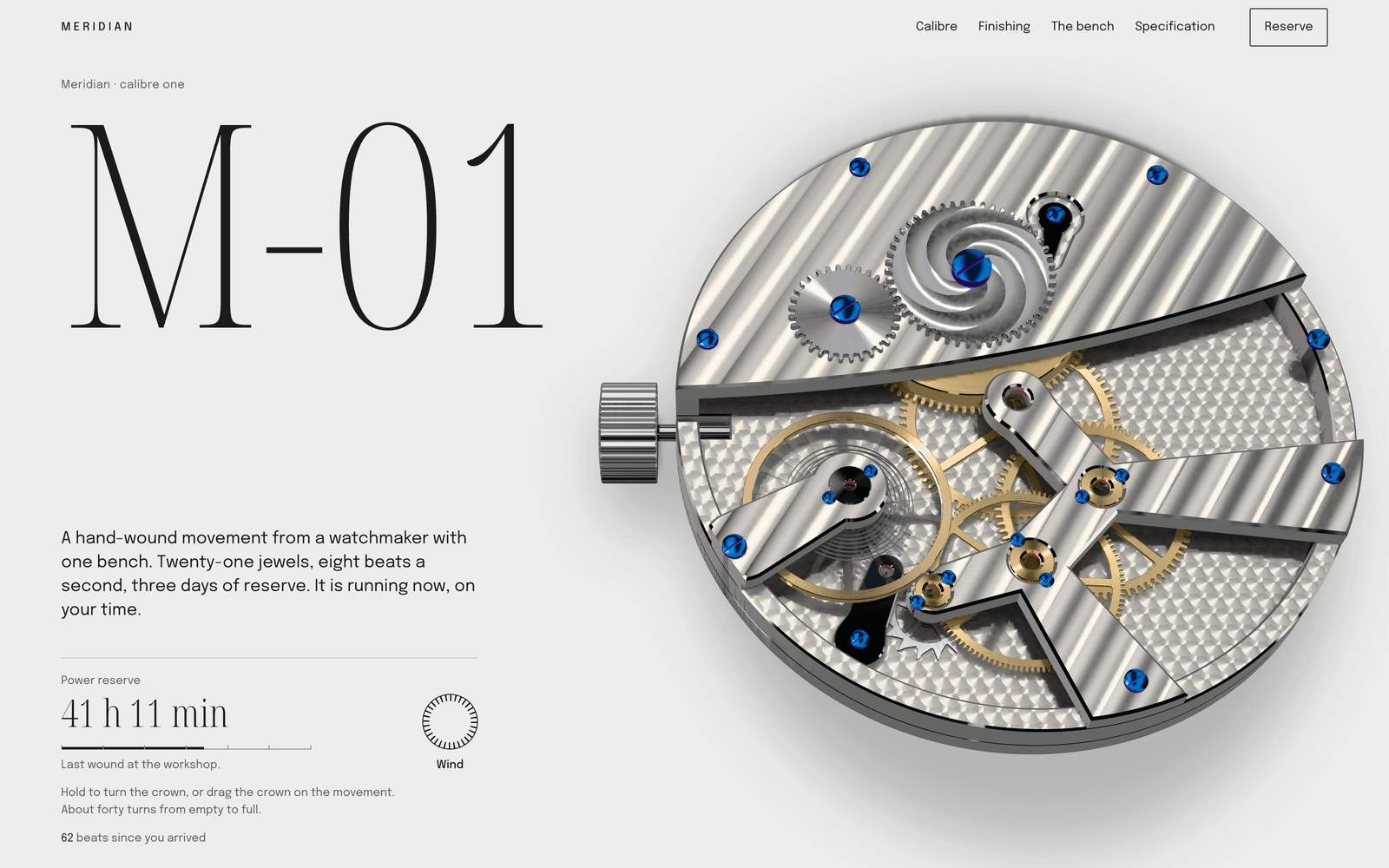
Meridian M-01 is a concept launch page for a fictional watchmaker's first calibre: the movement runs live at your own time, comes apart in service order and starts again when you wind it. It was made by the Laarpi team with Laarpi's library and process, with people steering every step, not produced end to end by SI. Its write-up covers how it was made and its measured load time on a throttled phone.
Sign-in and forms run on your own Supabase project, and checkout on your own Polar account, so the data and the payments sit in accounts you own; see the website backend. The site is plain HTML, CSS and JavaScript that you can read and edit beside the preview. Basic is $20 a month with 150 credits and up to 3 projects; Pro is $50 a month, or $40 billed yearly. The difference between an agent for websites and a general app builder is set out on vibe coding websites.
Who each one is for
- Stay with Lovable if you are building an app and its credits fit your month: it covers the frontend, the backend and hosting in one place.
- Base44 suits people who want apps with users, data and integrations without touching code.
- Bolt.new suits people who like Lovable's way of working and want a different product with the same shape.
- Replit suits people who want a full cloud workspace and an agent, for apps as well as sites.
- v0 suits product teams and developers who build interfaces and ship on Vercel.
- Cursor suits people who want to work in the code, in their own repository.
- Framer suits people building a website who want to lay out every element themselves.
- Laarpi suits people building a website who would rather describe it, with motion and 3D planned into the brief.
Where Laarpi is the wrong choice
- You are building an app. Accounts, dashboards, records and workflows belong in Lovable or one of the app builders above. Laarpi makes websites.
- You want to hand over files. Laarpi takes images as references for the design today; placing your own photos, documents and logos on the site is in development.
- You need the code in your own repository. Downloading a site's code is planned, not available. Lovable, Bolt.new and v0 sync with GitHub, and Cursor works in your repository from the start.
- A team will share the workspace. A shared team workspace is planned. Lovable includes unlimited workspace members on every plan.
- You want React or Next.js. Laarpi writes plain HTML, CSS and JavaScript.
Sources
Checked October 2026. Plans and features change; the linked pages are the authority.
- Lovable pricing: plans and FAQ, checked 9 October 2026
- Lovable docs: Subscription plans, checked 9 October 2026
- Lovable docs: Credits and usage, checked 9 October 2026
- Base44 pricing and FAQ, checked 9 October 2026
- Bolt pricing, checked 9 October 2026
- Bolt docs: GitHub for version control, checked 9 October 2026
- Cursor pricing, checked 9 October 2026
- Framer pricing (yearly billing shown), checked 9 October 2026
- Framer Help: HTML export and self-hosting, checked 9 October 2026
- Replit pricing, checked 9 October 2026
- Replit docs: Starter plan, checked 9 October 2026
- v0 pricing (US dollars), checked 9 October 2026
- v0 docs: What is v0?, checked 9 October 2026