Liquid Chrome: one polished object, a precise stage
A style for product launches that want a tactile hero instead of a screenshot. How one real-time object carries the page, the palettes and type around it, and how to keep the shine from turning into a cliché.
Palette and type
Palette
- Ground#CBD3DB
- Surface#BEC6CF
- Ink#0D1B2A
- Muted#4C5864
- Accent#007CB4
- Accent 2#FF4FD8
- Line#A5AEB8
Chrome sky
Brushed-silver ground and a navy ink; a cool cyan and a hot iridescent pink stand in for the reflections in polished metal.
- Ground#111B29
- Surface#252D39
- Ink#EDE6D6
- Muted#868785
- Accent#E0405A
- Accent 2#8FA9C7
- Line#464C53
Midnight crimson
Midnight navy, never pure black, with a parchment ink; crimson for the moment of tension and a cold steel blue for everything else.
- Ground#160830
- Surface#2A1C43
- Ink#F2E9FF
- Muted#867B9A
- Accent#FF9E3D
- Accent 2#9C7BFF
- Line#4B3E62
Ultraviolet ember
A violet-black night with a lavender-white ink; ember orange is the warmth in the room, a soft periwinkle the echo.
Type
Liquid Chrome
Syne
Polished, iridescent objects floating in a cool, precise interface. Product-launch energy without the gradient clichés.
Satoshi
Syne / Satoshi / 0123456789
Martian Mono
- Layout
- Split stages with one live object, specimen-plate framing marks, generous negative space, compact copy columns, tiers as aligned columns.
- Motion
- Scroll-reactive WebGL objects, mask reveals, magnetic CTAs, a pinned horizontal rail for the showcase.
Try it with a prompt
“A speaker cast from one piece of aluminium. The metal should look like it was just poured.”
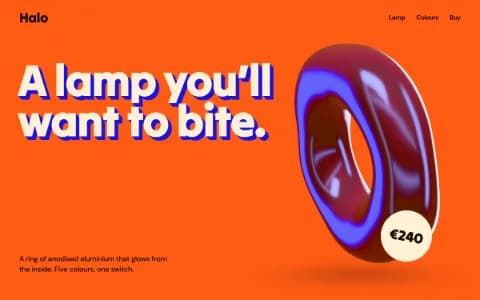
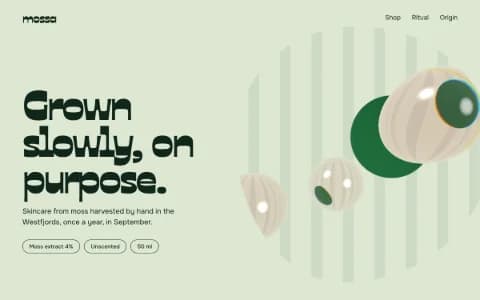
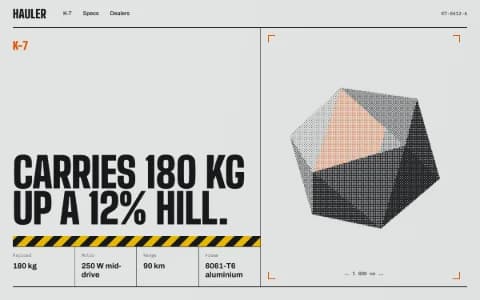
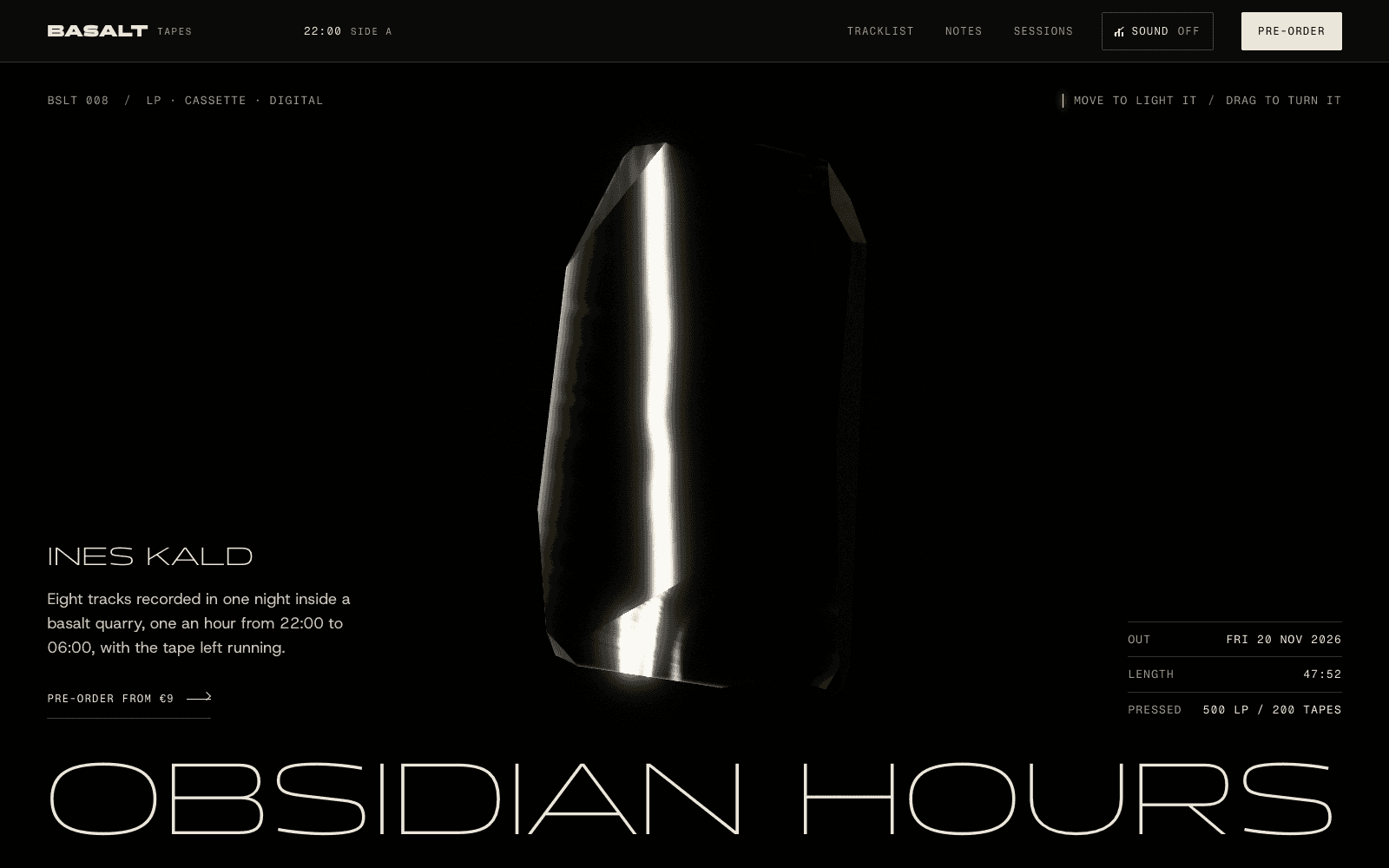
Start building in Liquid ChromeLiquid Chrome is the launch-day style. One polished, iridescent object hangs in a cool, precise interface. It leans toward the cursor, catches the light as you scroll, and makes the product feel like something you could pick up.
The trick is restraint around it. The object glitters. Nothing else does.
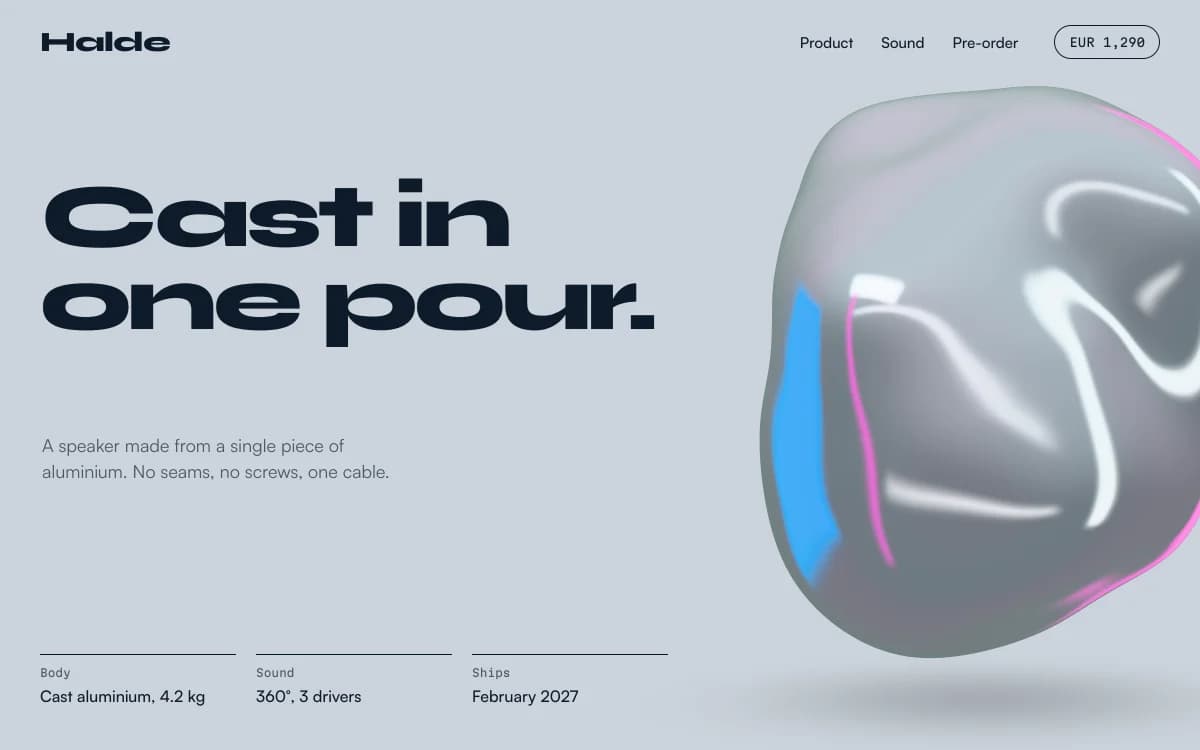
The specimen, for a fictional speaker cast from a single piece of aluminium, shows the core move: a headline on the left, a liquid-metal form on the right, three facts in a hairline row underneath. No gradient backdrop, no floating cards, no fake dashboard.
Where it comes from
Chrome has been the material of the future since the aerodynamic designs of the 1930s. It came back loudly at the turn of the millennium in what is now called the Y2K aesthetic: chrome type, liquid metal and iridescent plastics on album covers, phones and early websites.
What makes it new on the web is real-time rendering. A chrome object no longer has to be a static picture. It can reflect a studio built from the site's palette, deform under the cursor and turn as you scroll.
What defines it
| Element | The Liquid Chrome choice | Why |
|---|---|---|
| Hero | A split stage: copy on one side, one live object on the other | The object is the product's promise |
| Object | Liquid chrome with a thin-film iridescent skin, or refractive glass | Materials people want to touch |
| Framing | Specimen-plate marks, hairline rows of facts | Precision makes the shine look expensive |
| Copy | Compact columns, few words | The object does the talking |
| Colour | Cool silvers and navies, or deep night grounds with one hot accent | Reflections need a calm field |
| Pricing | Tiers as aligned columns | Comparison without card clutter |
Palettes
| Palette | Ground | Ink | Accent | Character |
|---|---|---|---|---|
| Chrome sky | #CBD3DB | #0D1B2A | #007CB4 | Brushed-silver ground; cyan and hot pink stand in for reflections |
| Midnight crimson | #111B29 | #EDE6D6 | #E0405A | Midnight navy, never pure black, with crimson for tension |
| Ultraviolet ember | #160830 | #F2E9FF | #FF9E3D | A violet-black night with ember orange as the warmth |
Notice what is missing: the purple-to-blue gradient. Liquid Chrome gets its colour from reflections on the object, not from a wash behind the page.
Type
- Display: Syne. It grows wider and wilder as it gets heavier; at weight 800 it is a statement.
- Text: Satoshi. A disciplined modernist grotesk from Fontshare, free for commercial use.
- Mono: Martian Mono. A wide mono with a width axis that reads like an instrument panel, for specs and prices.
Motion and depth
The centrepiece is a real-time object, and the library has three to start from:
- Chrome object: a liquid-metal form with an iridescent skin, lit by a procedural studio. It breathes, floats over a soft contact shadow and leans toward the pointer.
- Glass blob: thick refractive drops that melt into one another and bend whatever is behind them, with rainbow dispersion at the edges.
- Liquid field: marbled pigment rivers with a satin sheen that the cursor stirs.
The agent adapts these to the concept or writes a bespoke object. Around the object, motion is precise: masked reveals, magnetic calls to action, and a pinned horizontal rail for product details. See the 3D website builder for how the scene is planned, built and checked.
A typical page, section by section
Every site is designed for its own idea, so treat this as a sketch, not a template. A page in this style often runs like this:
- The split stage. Headline and one line of copy on one side, the live object on the other.
- Offset features. Two or three facts, each beside a different angle or state of the object.
- A gallery plane of details or colourways the visitor can drag through.
- A pinned rail that moves sideways through the product's story as you scroll down.
- Tiers as aligned columns, if there is more than one version, with the differences on the same lines.
- The closing call over a calm field, the object returning for one last turn.
Who it suits
| A strong fit | A poor fit |
|---|---|
| Product launches for hardware, audio, fragrance | Brands rooted in craft, earth and hand-made warmth |
| Software that wants a tactile hero instead of a screenshot (SaaS landing pages) | Content-heavy sites |
| Consumer tech, wearables, design objects | Restaurants and hospitality |
| Pre-order pages with one hero product | Large catalogues |
More on these in the use cases for product launch pages and SaaS landing pages.
How it goes wrong
- The gradient cliché. Iridescence spread across the background instead of living on the object. It turns into the purple-to-blue wash every generated site uses.
- Glass for no reason. Frosted-glass cards around every block. Liquid Chrome has one glassy thing, and it is the product.
- A heavy hero that blocks the page. The words must arrive first. The object fades in after, and pauses when off screen.
- A floating object with no idea. If the chrome blob could sit on any launch page, it is decoration. Tie it to the product: cast metal, poured glass, a liquid that becomes a shape.
- Low contrast on silver. Mid-grey grounds need dark inks. Every pairing is checked.
Making it yours
- "A speaker cast from one piece of aluminium. The metal should look like it was just poured."
- "A fragrance launch. The bottle is glass; the scent is the colour inside it."
- "A developer tool launch. No screenshots in the hero. One object that shows what the tool does."
For the same energy with more play, see Dimensional Pop. For softer living forms, Organic Biomorph. For engineering precision, Industrial Spec Sheet. To keep a 3D hero fast, read website performance with 3D.