Carrd alternatives for personal sites, landing pages and more
Six tools people move to from Carrd, checked against their own pricing pages on 9 October 2026: what each is for, what it costs, who it suits, and where Laarpi is the wrong choice.
Carrd makes simple, responsive one-page sites, and its paid plans start at $9 a year. People look for Carrd alternatives when a single page stops being enough: they need a blog, a page per project, a shop, a different way to design, or only a page of links. This page sets out six options with facts from each tool's own pricing page, checked on 9 October 2026, and says plainly when Carrd is still the better pick. The tools are in alphabetical order, with Laarpi last. For one-to-one comparisons with Laarpi, the compare hub covers Framer, Webflow, Wix and more.
What Carrd does well, and where people outgrow it
Carrd describes itself as "simple, free, fully responsive one-page sites for pretty much anything": a personal profile, a landing page that collects emails, a page for a project or an event. The free plan covers up to three sites per account with Carrd's core features, and those sites carry a "Made with Carrd" credit.
Its paid plans are priced by the year. Pro Lite, $9 a year, removes the branding for three sites. Pro Standard, $19 a year, adds your own domain, forms, embeds and analytics for up to 10 sites. Pro Plus, $49 a year, adds advanced forms, site downloads, redirects and password protection for up to 25 sites. A 7-day Pro trial needs no card.
The reasons people give for moving on are mostly about what Carrd is built to do:
- More than one page. Carrd is built for one-page sites. A blog, a portfolio with a page per project or a set of service pages needs a multi-page builder.
- A different way to design. Carrd is an editor you assemble the page in, from a template or a blank page. Some people want more layout control; others would rather not assemble the page at all.
- A page that is only links. If the page exists to sit in a social bio, a link-in-bio tool does that job directly.
Carrd and six alternatives, side by side
Facts are from each tool's own pricing page on 9 October 2026. Prices are entry prices in US dollars where the page states them; Linktree and Wix show prices in local currency by region, so check their pages for yours.
| Tool | What it is | What you publish | Free plan | Paid from | Best for |
|---|---|---|---|---|---|
| Carrd (for reference) | A builder for one-page sites | One-page sites | Up to 3 sites, with Carrd branding | Pro Lite, $9 a year; your own domain from Pro Standard, $19 a year | One page on the smallest budget |
| Framer | A visual site builder with AI agents, a CMS and hosting | Multi-page sites: 30 pages on Basic | On a Framer domain, with 500 AI credits to try | Basic, $10 a month per site, billed yearly | A multi-page site you lay out yourself |
| Linktree | A link-in-bio page | One page of links for your profiles | Unlimited links and basic analytics | Starter, Pro and Premium, priced by region | A social bio that points to everything else |
| Neocities | Hosting for sites you make by hand, with no ads | Any pages you write or upload | 1 GB of storage on a free subdomain | Supporter, $5 a month: 50 GB and your own domain | Hand-made personal and fan sites |
| Webflow | A visual builder with a CMS and hosting | Multi-page sites: 2 static pages on Starter, 300 on Basic | Starter, on a webflow.io domain | Basic, $15 a month billed yearly, or $25 monthly | Precise layout control and a CMS |
| Wix | A drag-and-drop builder with templates and business tools | Multi-page sites | With Wix branding | Light, Core, Business and Business Elite, priced by region | A quick start with bookings or a store built in |
| Laarpi (private beta) | A website agent, SI, that builds from a description | One-page or multi-page sites on a laarpi.site address | 30 credits a month, up to 3 projects, with a small mark | Pro, $50 a month | A site you describe rather than assemble |
We have not run a side-by-side test of these tools, so this page makes no claim about which produces the best site. It describes what each one is for and what it costs.
Framer: a designed site with room to grow
Framer is a visual site builder with AI agents, a CMS and managed hosting. Where Carrd stops at one page, Framer's Basic plan, which Framer pitches at creative personal sites, allows 30 pages and two CMS collections, so a portfolio with a page per project or a small blog fits. The free plan publishes on a Framer domain with 500 AI credits to try and 1 GB of bandwidth. Basic is $10 a month per site, billed yearly, with 1,000 AI credits a month and your own domain; Pro, $30 a month, raises the limits to 150 pages and 10 CMS collections and adds a staging environment. Framer's help centre says it does not offer HTML export for self-hosting, so the site stays on Framer.
We compare it with Laarpi line by line in Laarpi vs Framer.
Linktree: if the page is only links
If your Carrd site is mostly a profile and a list of links for an Instagram or TikTok bio, a link-in-bio tool is built for that one job. Linktree's free plan includes unlimited links, core appearance options and basic analytics. The paid Starter, Pro and Premium plans add more control, analytics, commerce and, on Premium, removable Linktree branding. Linktree prices its plans by region and shows them in your local currency.
Neocities: free, hand-made and ad-free
Neocities hosts sites you make yourself, and says it will never put advertising on them. The free plan gives you 1 GB of storage, 200 GB of bandwidth and a free subdomain with SSL. The Supporter plan, $5 a month, raises that to 50 GB and 3,000 GB, and adds your own domain and more than one site. You write or upload the HTML and CSS yourself, in its browser editor or with its command-line tool, and Neocities itself is open source.
It is more hands-on than Carrd. In exchange, nothing stands between you and the code, and the host promises never to add advertising.
Webflow: visual building with a CMS
Webflow is a visual development platform: you build in the Designer, with a CMS and hosting around it. The free Starter plan publishes on a webflow.io domain with two static pages, 1 GB of bandwidth and 50 form submissions. Basic, for sites that don't need a CMS, is $15 a month billed yearly or $25 monthly, with your own domain, 300 static pages and unlimited form submissions. Premium, $25 a month billed yearly or $39 monthly, adds the CMS. Prices are per site, in US dollars. Laarpi vs Webflow covers the two side by side.
Wix: drag and drop, with a free plan
Wix is a website builder with templates, AI creation tools and business features such as payments, scheduling and a store. Its free plan includes hosting, the drag-and-drop editor and thousands of templates, with Wix branding on the site. The paid plans, Light, Core, Business and Business Elite, add your own domain and remove Wix's branding, with payments, scheduling and ecommerce from Core up. Wix shows prices and offers for your region, so check its plans page for yours. For how Wix and Laarpi differ, read Laarpi vs Wix.
Laarpi: describe the site instead of assembling it
Laarpi is in private beta. You describe the site in a sentence or two. Laarpi's agent, SI, asks the few questions that change the result, as cards with options, then writes a brief you can edit: concept, palette, type, sections and motion. It builds the site live, you direct it in words or by pointing at the page, and you publish to a laarpi.site address. Every version stays in the site's history, and a site can be one page or several. How it works walks through each step.
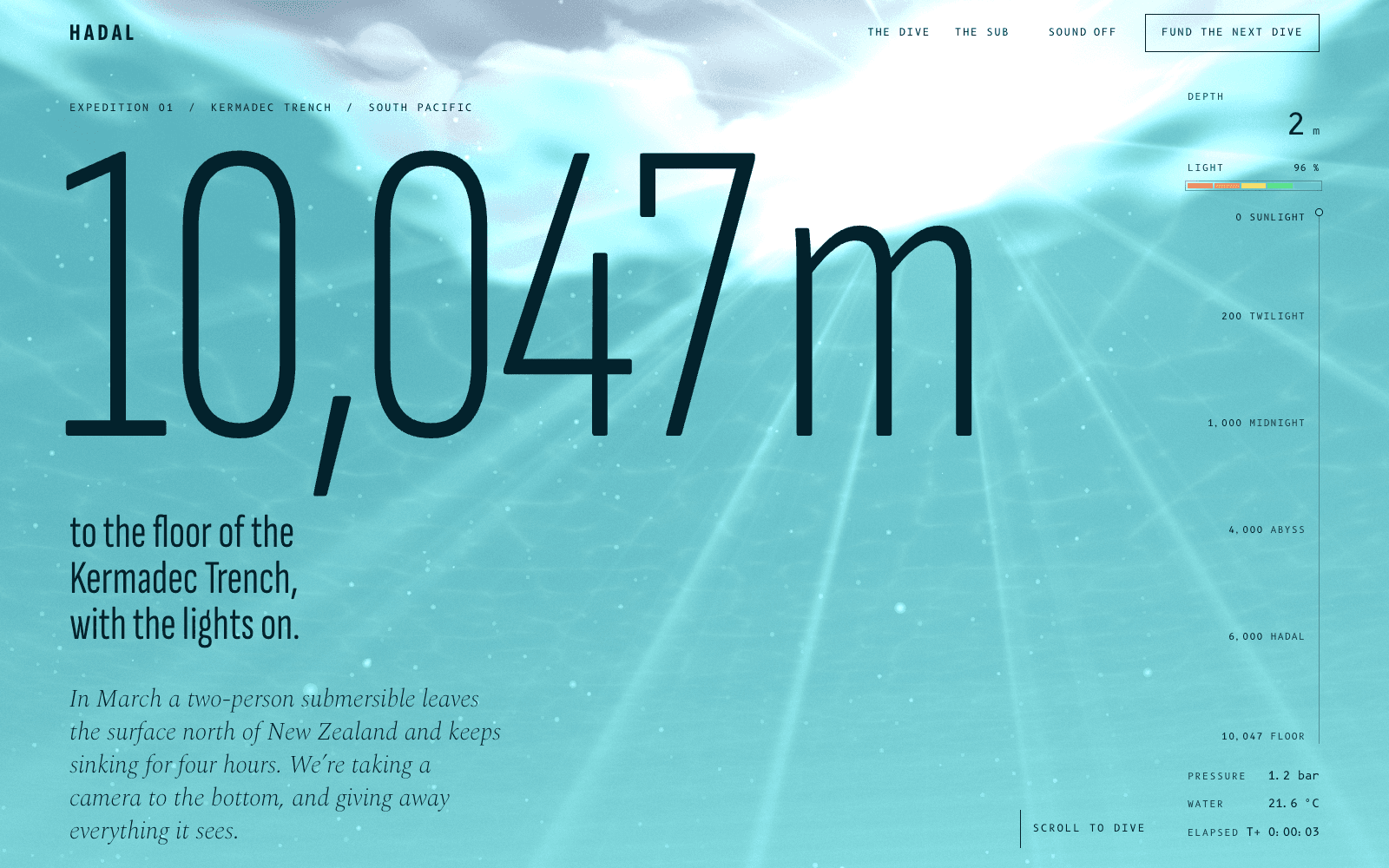
HADAL is a one-page concept site for a fictional deep-sea expedition: scrolling is the dive, and below 1,000 metres your cursor is the submarine's lamp. On our throttled phone profile (slow 4G, CPU slowed four times) its first full frame arrived in 3.8 seconds, after 369 KB, measured on 6 October 2026. Like every showcase site, it was made by the Laarpi team with Laarpi's library and process, with people steering every step, not produced end to end by SI. Its write-up covers how it was made.
Forms and sign-in run on your own Supabase project, and checkout on your own Polar account, so the sign-ups and the money land in accounts you own; see the website backend. Basic is $20 a month with 150 credits, up to 3 projects and a small "Made with Laarpi" mark. Pro is $50 a month, or $40 billed yearly.
What Laarpi doesn't do today: placing your own photos, documents and logos on the site is in development (images can be attached as references for the design), and downloading a site's code is planned rather than available.
Who each one is for
- Stay with Carrd if one page does the job and price matters most.
- Framer suits people who want to lay out a multi-page site themselves and keep it on managed hosting.
- Linktree suits a page whose only job is to hold links for a social profile.
- Neocities suits people who enjoy writing HTML and want a free, ad-free home for it.
- Webflow suits people who want precise control of layout and content and are willing to learn the Designer.
- Wix suits a quick start from a template, with bookings, payments or a store in the same place.
- Laarpi suits people who would rather describe the site than assemble it, and want motion or 3D planned into it from the start.
Where Laarpi is the wrong choice
- The cheapest single page. Carrd's Pro Standard is $19 a year with your own domain. Laarpi's Pro plan is $50 a month.
- Placing every element by hand. Laarpi has no drag-and-drop canvas: you direct it in words or by pointing at the page. Carrd, Framer, Webflow and Wix are editors built for that.
- Your own photos on the site today. Images work as design references now; placing your photos, documents and logos on the site is still in development.
- Keeping the files. Downloading a site's code is planned, not available. Carrd's Pro Plus lists site downloads, and on Neocities the files are yours from the start.
- Only links. A link-in-bio tool is simpler, and Linktree has a free plan.
If one page is still the job, a product launch page or a portfolio website shows how Laarpi approaches each.
Sources
Checked October 2026. Plans and features change; the linked pages are the authority.
- Carrd: Pro plans and features, checked 9 October 2026
- Carrd home page (free plan and branding), checked 9 October 2026
- Framer pricing (yearly billing shown), checked 9 October 2026
- Framer Help: HTML export and self-hosting, checked 9 October 2026
- Linktree pricing (shown in local currency by region), checked 9 October 2026
- Neocities: free and Supporter plans, checked 9 October 2026
- Webflow pricing (US dollars, per site), checked 9 October 2026
- Wix plans (prices shown by region), checked 9 October 2026