Salt & Smoke
One fire on an Oregon bluff, sunset to moonrise. Tonight's menu is written in its smoke.
Laarpi Studio
Scroll throws a stoneware vase, then fires it to 1280 °C behind a kiln spyhole.
A concept site for a fictional one-person stoneware studio. Your scroll is the potter's hands: a wet lump of clay is centred, pulled, trimmed, glazed and fired into the vase the page then offers.
Aster & Kiln is a site for a one-person stoneware studio in Lisbon. You watch one vase get made. Your scroll is the potter's hands: 1.8 kg of wet red stoneware is centred, opened, pulled, shaped, trimmed, glazed and fired to 1280 °C, and comes out as AK–26, a celadon vase the page then offers alongside the rest of the spring firing.
It is a concept site, made by the Laarpi team with Laarpi's library and process. The studio, the potter and the pieces are invented.
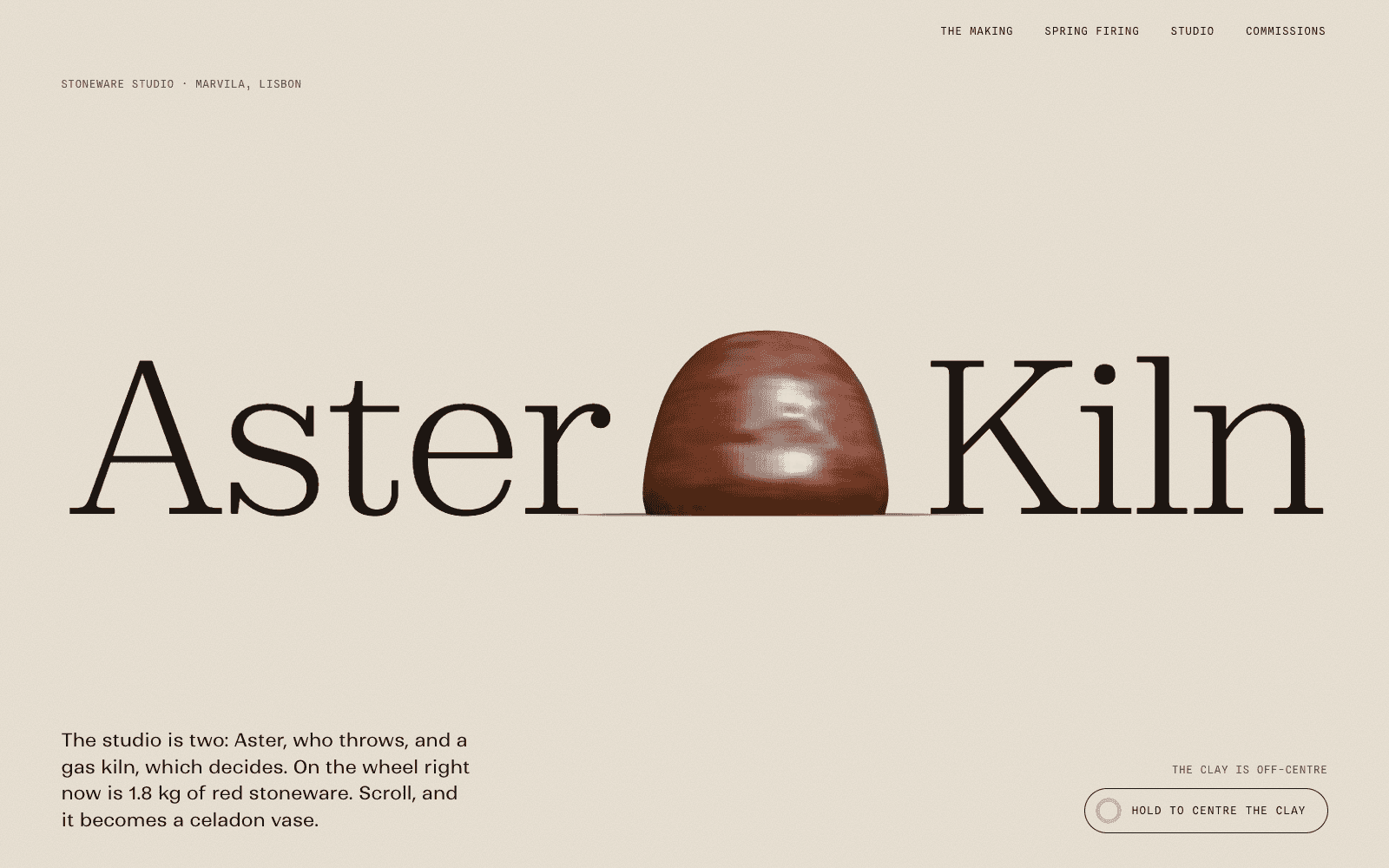
The studio is two characters: Aster, who throws, and the kiln, which decides. In the wordmark, the wet lump of clay stands where the ampersand would be, because the clay is what joins them.
The brief named three audiences: people who buy handmade ceramics, restaurants and interior designers who commission pieces, and visitors who want a Saturday at the wheel. It set the goals of selling the spring firing, starting commissions, booking visits, and showing the process honestly, from wet clay to the kiln.
It also listed what to avoid: artisanal clichés and lifestyle styling, stock photography, invented testimonials and follower counts, 3D objects built from basic shapes, and anything implying a real studio or a real person.
The palette follows the clay. Raw-slip bone is the page, terracotta is wet stoneware, celadon is what comes out of the kiln, and soot is the inside of the kiln and the type. The ember orange exists only inside the kiln, so the firing reads as a different place.
There is one 3D mesh: a vessel turned on the GPU from a 256-point profile (underside, outer wall, rolled lip, inner wall). The profile morphs through eight states as you scroll, which is how one lump becomes a vase without swapping models.
The material is an extended physical material. CC0 ambientCG clay maps give the wet and leather-hard surfaces, a clearcoat carries the water film, glaze thickness follows the curvature, and a CC0 glazed-ceramic height map adds variation. Throwing rings, iron speckle, a wiped foot and the blackbody glow of the kiln are computed. The light is a CC0 Poly Haven studio HDRI. The same profiles draw the six collection pieces at true scale and the section drawings in the reduced-motion version.
Zodiak Light carries the wordmark, set edge to edge, and the kiln counter in italic figures, the loudest thing on the page. Ranade, a humanist sans with a little brush in it, sets the prose. Spline Sans Mono carries catalogue numbers, dimensions and the firing schedule, like a kiln log.
This is the scroll-as-process pattern: one object changes state section by section, and the copy beside it explains each state. The scrollytelling website examples and 3D website examples show it beside our other concept sites, and animated websites covers motion that carries a story.
Measured on 6 October 2026, cold, with an empty cache, on our phone profile: slow 4G (1.6 Mbps down, 150 ms round trip), CPU slowed four times, a 390 × 844 screen.
| What | Measured |
|---|---|
| First paint, with the "1.8 kg" loader | 1.6 s |
| First frame with the clay fully drawn | 11.8 s |
| Transferred | 1,904 KB, 19 requests, one origin |
On a 10 Mbps connection without the CPU slowdown, the clay was drawn at 2.7 s. Most of the weight is the lighting file and three material maps, which the slow link takes time to carry. The loader shows real progress from the first paint. Rendering resolution is capped (2× on desktop, 1.5× on phones), rendering skips frames when no vessel is on screen, and everything is released when you leave. Fast websites with 3D covers the trade-offs.
With reduced motion on, the scroll-driven making is replaced by a static catalogue: archaeological section drawings for each step and a still render of every pot. Nothing flashes. Hold to centre works with Space and Enter as well as a pointer, the eight steps can be reached from numbered buttons, and the menu closes with Escape. Accessible motion explains how to plan a reduced-motion version from the start.
A concept site made by the Laarpi team with Laarpi's library and process. It was not produced end to end by SI, Laarpi's website agent. Sites SI builds on its own carry a "Built by SI" label with their build time and cost.
| Piece | By | Licence |
|---|---|---|
| Brown Photostudio 02 (HDRI) | Sergej Majboroda, Poly Haven | CC0 1.0 |
| Clay 002 | ambientCG | CC0 1.0 |
| Glazed Terracotta 003 | ambientCG | CC0 1.0 |
| Zodiak | Jérémie Hornus, Gaetan Baehr, Jean-Baptiste Morizot, Alisa Nowak, Theo Guillard | ITF Free Font License |
| Ranade | Easha Ranade, Indian Type Foundry | ITF Free Font License |
| Spline Sans Mono | Eben Sorkin, Mirko Velimirović | SIL OFL 1.1 |
| three.js 0.186.1 | three.js authors | MIT |
| GSAP 3.15.0 | GreenSock | Standard No Charge License |
| Lenis 1.3.26 | darkroom.engineering | MIT |
The pot geometry, speckle, throwing rings, crazing, kiln glow, section drawings and paper grain are generated in the browser by code written for this site.
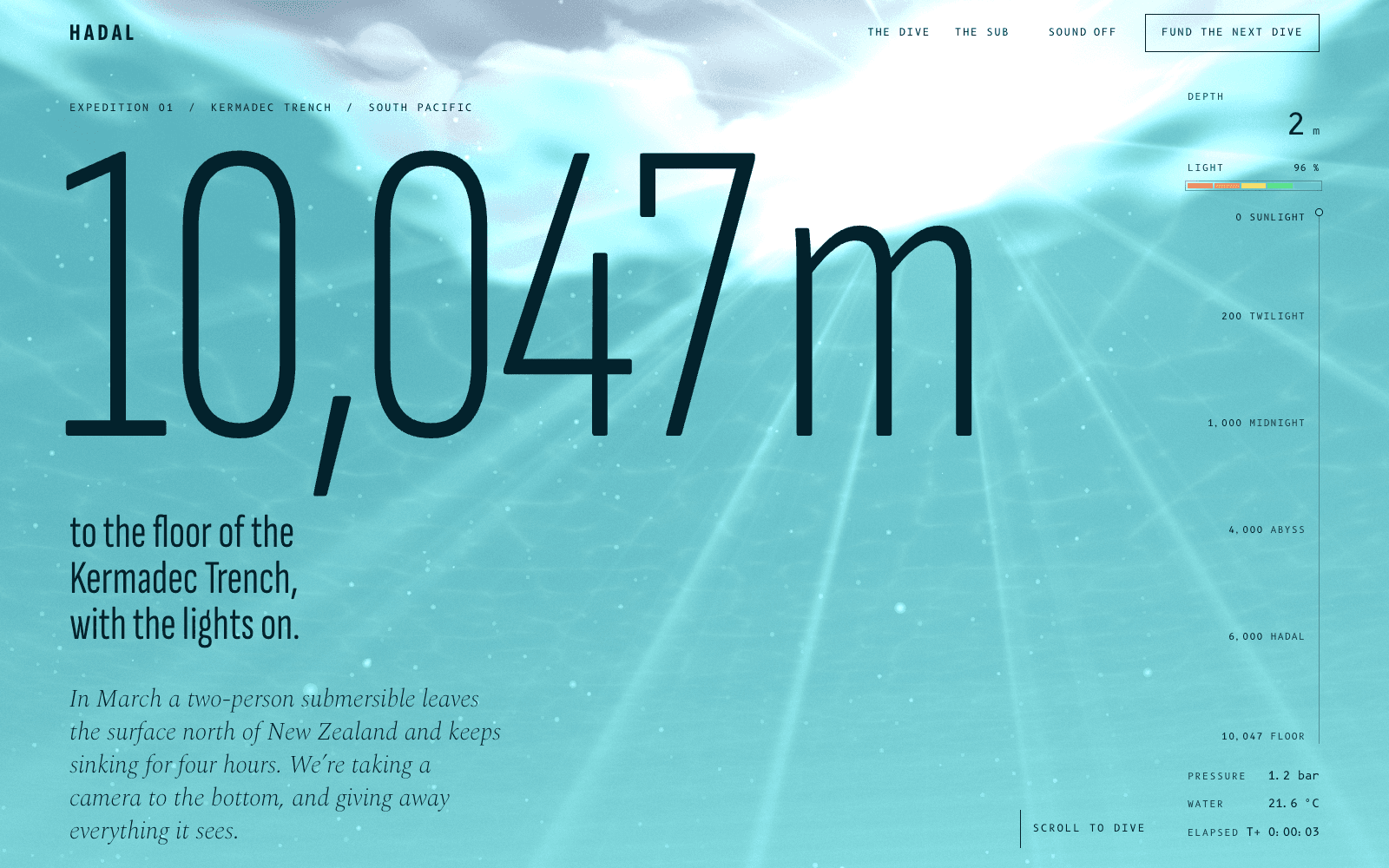
For two more scroll-driven objects, see HADAL, a scroll story into the deep ocean, and Meridian M-01, a watch movement that comes apart and goes back together. To start your own process story from this one, remix it.
No. The studio, the potter and the pieces are fictional, made up for this concept site by the Laarpi team. The brief said outright that the site must not imply a real studio or a real person.
No. The buy, commission and visit buttons use Laarpi's Polar checkout module, but no store is connected to this concept, so they are disabled and nothing is sold or booked.
No. Every pot is rendered live from its own profile curve. The only downloaded images are three CC0 material textures for clay and glaze and one CC0 lighting file.
No. It was made by the Laarpi team with Laarpi's library and process, with people steering every step. Sites that SI builds end to end are labelled "Built by SI" and show their build time and cost.
A static catalogue. Each making step is shown as an archaeological section drawing, and each finished pot as a still render, so the story reads without any movement.
Yes. Remix copies the site's code and plan into your own project, then you tell the agent what to change. The making steps, the object and the words would be yours; the scroll-as-process structure carries over to anything made in stages.
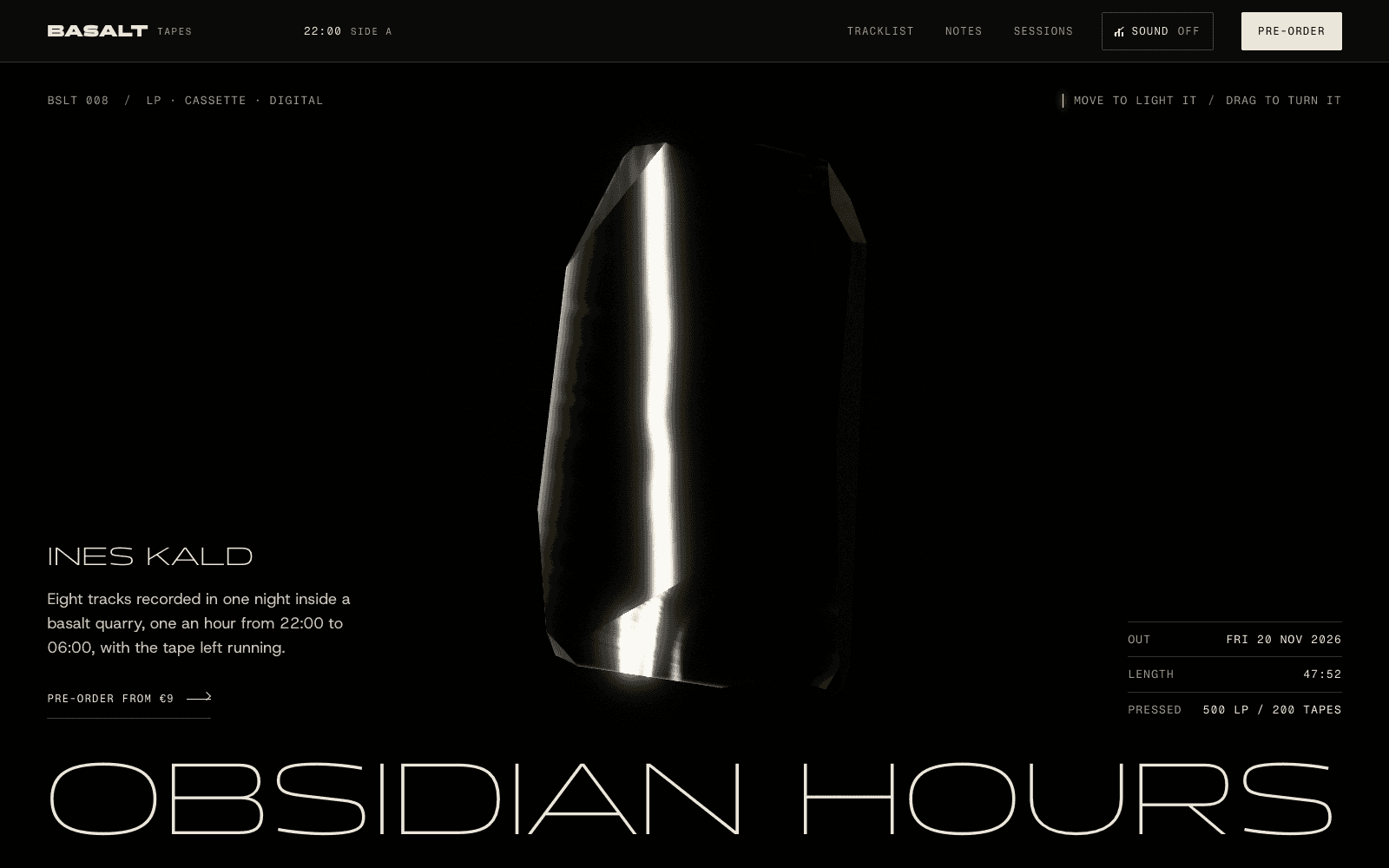
One fire on an Oregon bluff, sunset to moonrise. Tonight's menu is written in its smoke.
Laarpi Studio
A Eurorack voice you can play in the page: turn it, patch it, take it apart, hear it.
Laarpi Studio
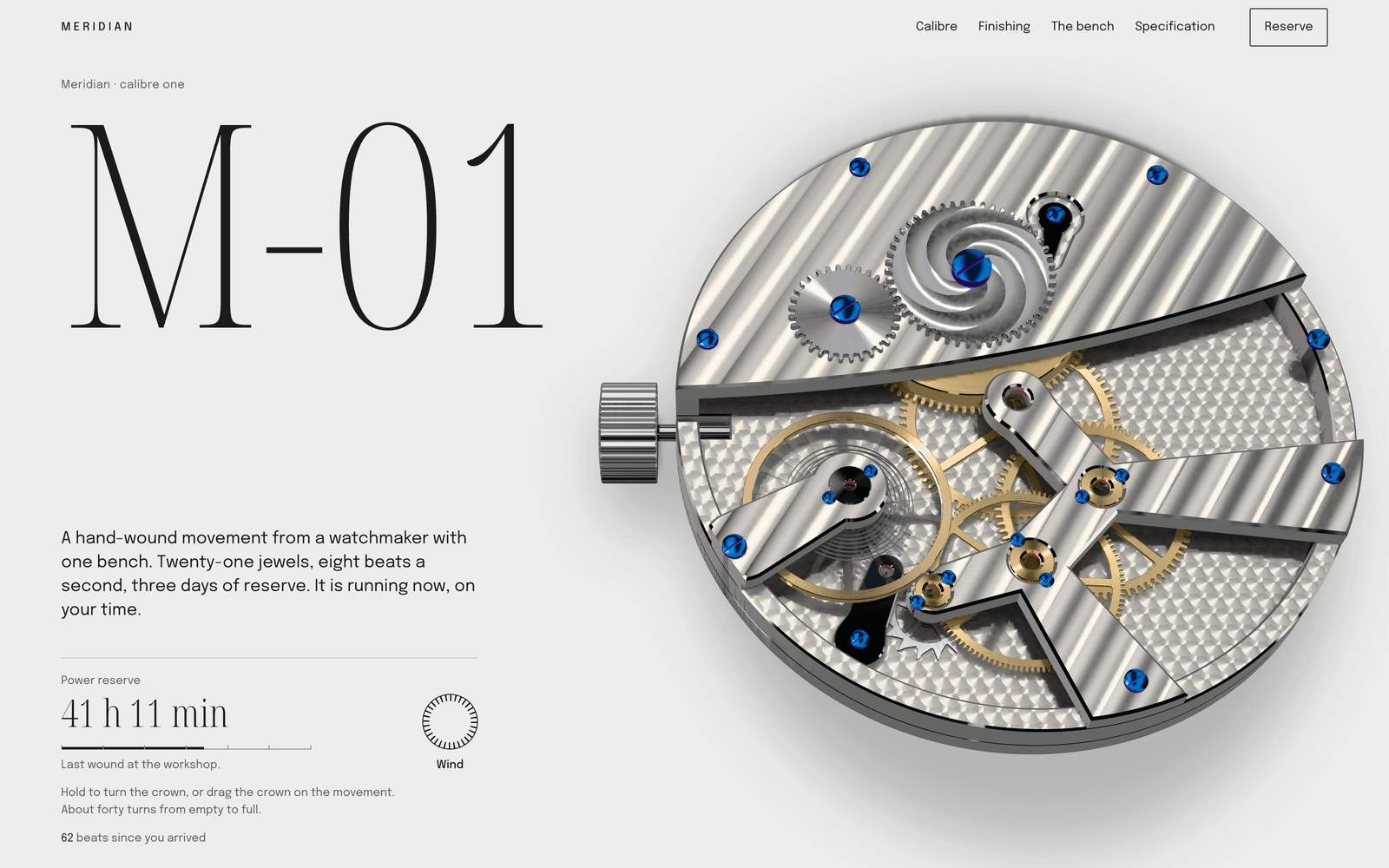
A hand-wound calibre you can wind, take apart under a loupe and watch start again.
Laarpi Studio
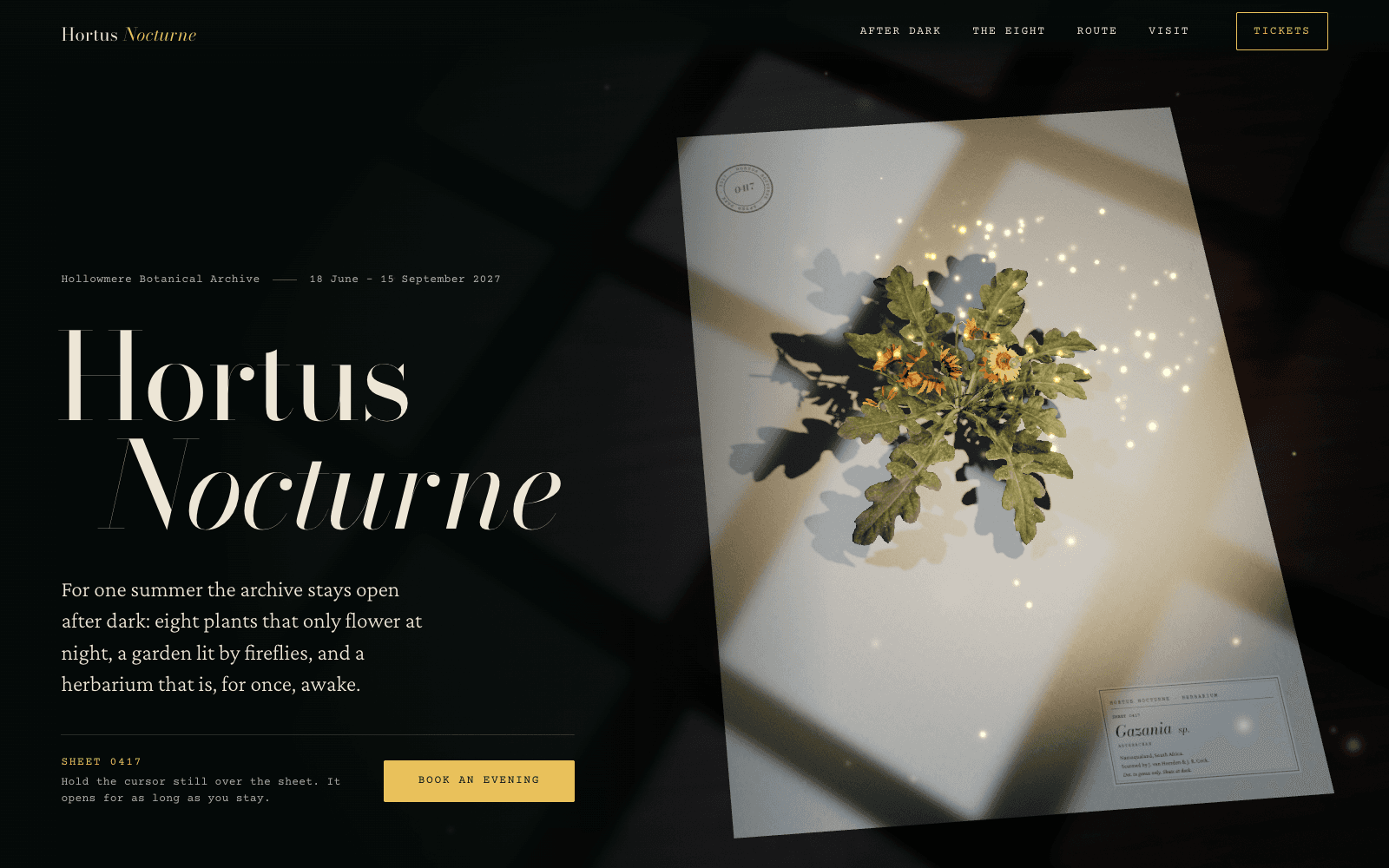
A pressed gazania that stands up and blooms only while you hold the cursor still.
Laarpi Studio
Remix this site, or describe a new one. It asks what matters, then designs and builds it from scratch.