Laarpi vs Lovable
A fair, dated comparison of Lovable's app builder and Laarpi's website agent, with sources for every Lovable fact.
The short answer. Choose Lovable if you are building an app, or a site with app parts: accounts, dashboards, records, workflows, a hosted backend you never have to open, or a store with Shopify behind it. Choose Laarpi if you are building a website whose look and movement are most of the job, and you want real-time 3D and motion planned into the brief, with sign-in, forms or checkout on your own Supabase and Polar accounts.
Both are agents you talk to. Lovable covers a wide range of web software. Laarpi does one thing: websites, from the first thought to the published site.
| Compared | Laarpi | Lovable |
|---|---|---|
| Built for | Websites: brands, launches, portfolios, events | Web apps and websites: SaaS, internal tools, prototypes, sites |
| Before it builds | SI asks a few questions as cards, then writes a brief you can edit | Three design directions on a first UI prompt; question cards; Plan mode |
| Real-time 3D | three.js scenes planned in the brief, with a still version for reduced motion | When you ask; it can add libraries such as three.js |
| Files you can attach | Images as design references today; documents, logos and links in development | Images, PDF, Word, Excel, PowerPoint, audio and Figma files; up to 10 files a message |
| Code | Plain HTML, CSS and JavaScript, readable and editable in the studio; download planned | A React app; Git sync on every plan, code download on paid plans |
| Backend | Your own Supabase project: sign-in and forms | Lovable Cloud (built on Supabase's open-source foundation), or your own Supabase |
| Payments | Your own Polar account: checkout for digital goods | Paddle or Stripe built in on Pro and up; your own Stripe on Free; Shopify for physical goods |
| SEO rendering | Static HTML with the copy in the page | Server rendering by default for new apps since 13 May 2026 |
| Domains | laarpi.site address; custom domains on paid plans | Custom domains on paid plans; buy one in Lovable; connected domains stay up after a downgrade |
| Paid plans fromA credit buys different work in each product; see the pricing section. | $25 a month for 250 credits, or $20 billed yearly | $25 a month for 100 credits, or $250 a year |
Every Lovable fact here comes from Lovable's pricing page, documentation and changelog, checked on 6 October 2026, and each is listed in the sources. Laarpi is in private beta; its column describes only what ships today. Both products change fast, so check the sources before you decide.
What each is built for
Lovable describes itself as a way to build apps and websites by chatting. It writes the frontend and the backend, hosts the result, and has a built-in backend called Lovable Cloud with a database, storage, authentication, realtime and functions, plus email, jobs, secrets and logs. It is built on Supabase's open-source foundation.
Laarpi is a website agent. You describe the site. Laarpi's agent, SI, asks the few questions that change the result, writes a brief you can edit (concept, palette, type, sections, motion), builds the site live, checks its own screenshots at desktop and phone sizes and at six layout widths, and takes your direction in words or by pointing at the page. How it works walks through it.
A quick test: write one sentence about what you are making and look at the nouns. Accounts, dashboards, records, admin screens: that is an app. A brand, a launch, a body of work, an event, a place: that is a website.
Design: how each decides the look
Lovable. On a first message that asks for anything with a UI, Lovable shows three design directions by default, so you pick a visual approach before it builds. It also uses question cards when it needs an answer, and Plan mode lets you think a change through before any code moves. On paid plans, design systems let you lock in tokens and components; when a project uses one, Lovable skips the directions step and builds with those rules.
Laarpi. SI asks its questions as cards with concrete options (palette swatches, type specimens, a choice between structures), then commits the answers to a written brief. The brief names one concept and the palette, type, layout and motion that serve it. You can change any line before the build, and again by pointing at the result. SI avoids the most common defaults by rule: overused typefaces as the main face, purple-to-blue gradients, a grid of three icon cards as the main pattern.
The difference is where the decisions live. In Lovable, a direction you pick and the prompts that follow. In Laarpi, a brief you can read and edit, which every later change works from.
Real-time 3D and motion
Lovable can install npm libraries, so it can add three.js or an animation library when you ask, and write the code that uses them.
In Laarpi, 3D and motion are planned with the concept. The brief says what the 3D centrepiece is, how it answers scroll and cursor, and why the story needs it. SI writes the scene in three.js, lights it with open-source HDR environments, uses real open-source models for real objects (credited), caps rendering resolution on phones, pauses it when it scrolls out of view and ships a composed still version for visitors who turn motion off.
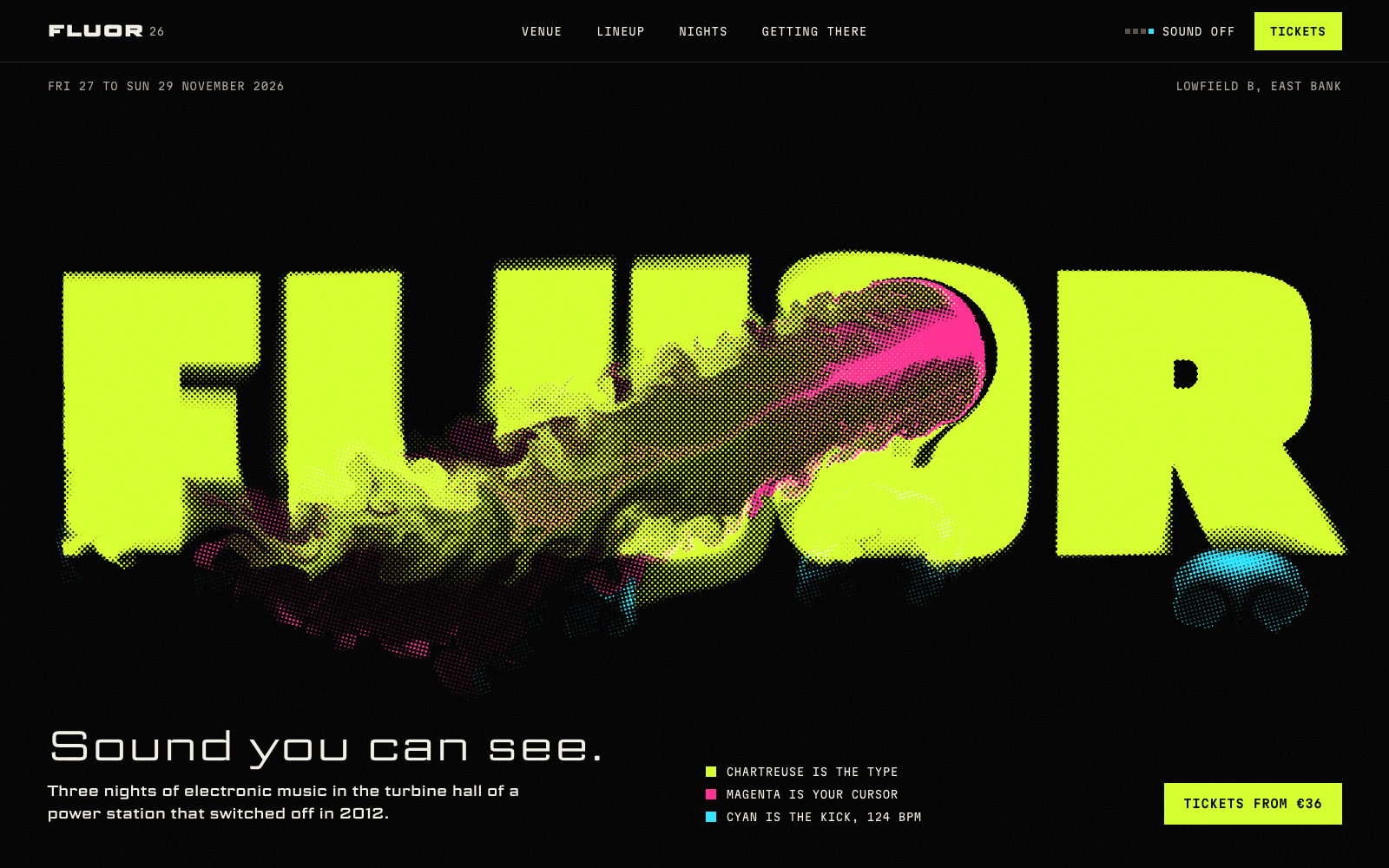
FLUOR 26 is a concept site for an invented festival, with type in live fluorescent ink that the cursor stirs and the kick drum pushes. It was made by the Laarpi team with Laarpi's library and process, with people steering every step, not produced end to end by SI. Its write-up covers the technique and its measured load time on a throttled phone.
More on how a scene is planned, lit and checked in the 3D website builder.
What you can hand over
This is a Lovable strength today. Lovable reads images, PDF, Word, Excel and PowerPoint files and audio recordings, up to 10 files a message, with files up to 20 MB on Free and 256 MB on paid plans. Since August 2026 it also reads Figma .fig files dropped into the chat.
Laarpi takes text and images today. Images are used as references for the design. Attaching photos, documents, logos and links that SI places on the site is in development, and this page will change when it ships.
Code and SEO
A Lovable project is a React app. Git sync with GitHub, GitLab or Bitbucket is on every plan; editing and downloading the code are on paid plans. It is the right shape for an app a development team will keep growing.
A Laarpi site is plain files: semantic HTML with the copy in the page, CSS and JavaScript modules, with libraries such as three.js and GSAP loaded from pinned CDN versions through an import map. There is no build step. You can read and edit the code beside the preview, and every edit becomes a version. Downloading the code is planned and not available yet.
On SEO, the old difference is gone. Lovable apps created from 13 May 2026 use TanStack Start with server rendering by default, so search engines and link previews get real HTML on the first request, and older projects can migrate in place. Laarpi's static HTML gives the same thing. Treat rendering as parity; the page's content and links are what separate sites in search.
Backend and payments
Lovable offers two backend paths: Lovable Cloud, hosted by Lovable and billed through its credits after the monthly Cloud grant, or your own Supabase project. Its docs note there is no one-click move from Cloud to your own Supabase later, so choose early. Payments are built in with Paddle (as merchant of record) or Stripe on Pro and up; on Free you can connect your own Stripe account. For physical products, Lovable integrates with Shopify.
Laarpi puts the backend on accounts you own from the start:
- Supabase: SI sets up sign-in and forms in your own Supabase project. Supabase bills you directly under its own plans.
- Polar: SI sets up checkout in your own Polar account and wires it to the buttons on your site. Polar suits digital goods such as memberships, downloads and subscriptions; it is not a store for physical products.
See the website backend and website payments.
Pricing and credits
Both price in credits, and a credit buys different work in each. Lovable prices below are from its pricing page and docs on 6 October 2026. Laarpi's prices show in your currency.
| Lovable | Laarpi | |
|---|---|---|
| Free | 5 build credits a day (up to 30 a month), a daily chat allowance, 20 Cloud credits and 4 AI credits a month | $0: 30 credits a month, up to 3 projects, a laarpi.site address with a small mark |
| Entry paid plan | Pro: $25 a month for 100 credits, or $250 a year | Pro: $25 a month for 250 credits, or $20 billed yearly; 3 custom domains |
| More capacity | Pro with 400 credits for $100 a month, and tiers up to $22,500 a year | Max: $100 a month for 1,200 credits; 10 custom domains |
| Teams | Business costs double the Pro rate; unlimited members on every plan | Business: $50 a seat a month, 600 credits per seat; 25 custom domains |
| What a credit pays for | Building, chat beyond the daily allowance, hosting, Cloud and AI features in your app | SI's work only, metered by what each turn costs |
| Unused credits | Monthly credits expire two months after they are issued | A monthly allowance, no rollover |
Lovable publishes illustrative costs: building a landing page with images is about 2.00 credits, removing a footer 0.90, a small style change 0.50, and each Plan mode message 1 credit. Those make 100 Pro credits go a long way on small sites. On Laarpi, hosting on laarpi.site and custom domains don't use credits, and Supabase and Polar bill you directly. See the pricing page for Laarpi's plans.
Domains and badges
Both put a badge on free sites and let paid plans remove it. Lovable's paid plans add custom domains, which you can connect or buy inside Lovable, and its docs say connected domains keep serving after a downgrade or cancellation; only connecting a new domain needs a paid plan.
Laarpi's free sites carry a small "Made with Laarpi" mark on a laarpi.site address. Pro adds 3 custom domains, Max 10 and Business 25; you add the DNS records the studio shows you. See custom domains.
Choose Lovable if
- You are building an app, not only a website: logins, dashboards, records, workflows.
- You want one place for everything, including a hosted backend you never open.
- You have material to hand over: PDFs, decks, spreadsheets, audio or Figma files.
- You sell physical products through Shopify, or want Paddle or Stripe built in.
- A team will share the workspace, with unlimited members on every plan.
Choose Laarpi if
- The website is the product, or its first impression, and its look and movement are most of the job.
- You want real-time 3D and motion planned into the brief, with phone limits and a still version for reduced motion.
- You want a written brief you can read and edit line by line.
- You want sign-in, forms or checkout on your own Supabase and Polar accounts from day one.
Laarpi is in private beta. Building a site that is half app, half website? Use both, joined by your domain. Comparing other agents? See Laarpi vs Bolt, Laarpi vs v0 and the compare hub.
Sources
Checked October 2026. Plans and features change; the linked pages are the authority.
- Lovable pricing and FAQ, checked 6 October 2026
- Lovable docs: Subscription plans
- Lovable docs: Credits and usage
- Lovable docs: Design guidance
- Lovable docs: Project chat (attachments)
- Lovable docs: Cloud
- Lovable docs: Payments
- Lovable docs: Custom domains
- Lovable docs: Git sync
- Lovable changelog (TanStack Start with server rendering by default, 13 May 2026)