Salt & Smoke
One fire on an Oregon bluff, sunset to moonrise. Tonight's menu is written in its smoke.
Laarpi Studio
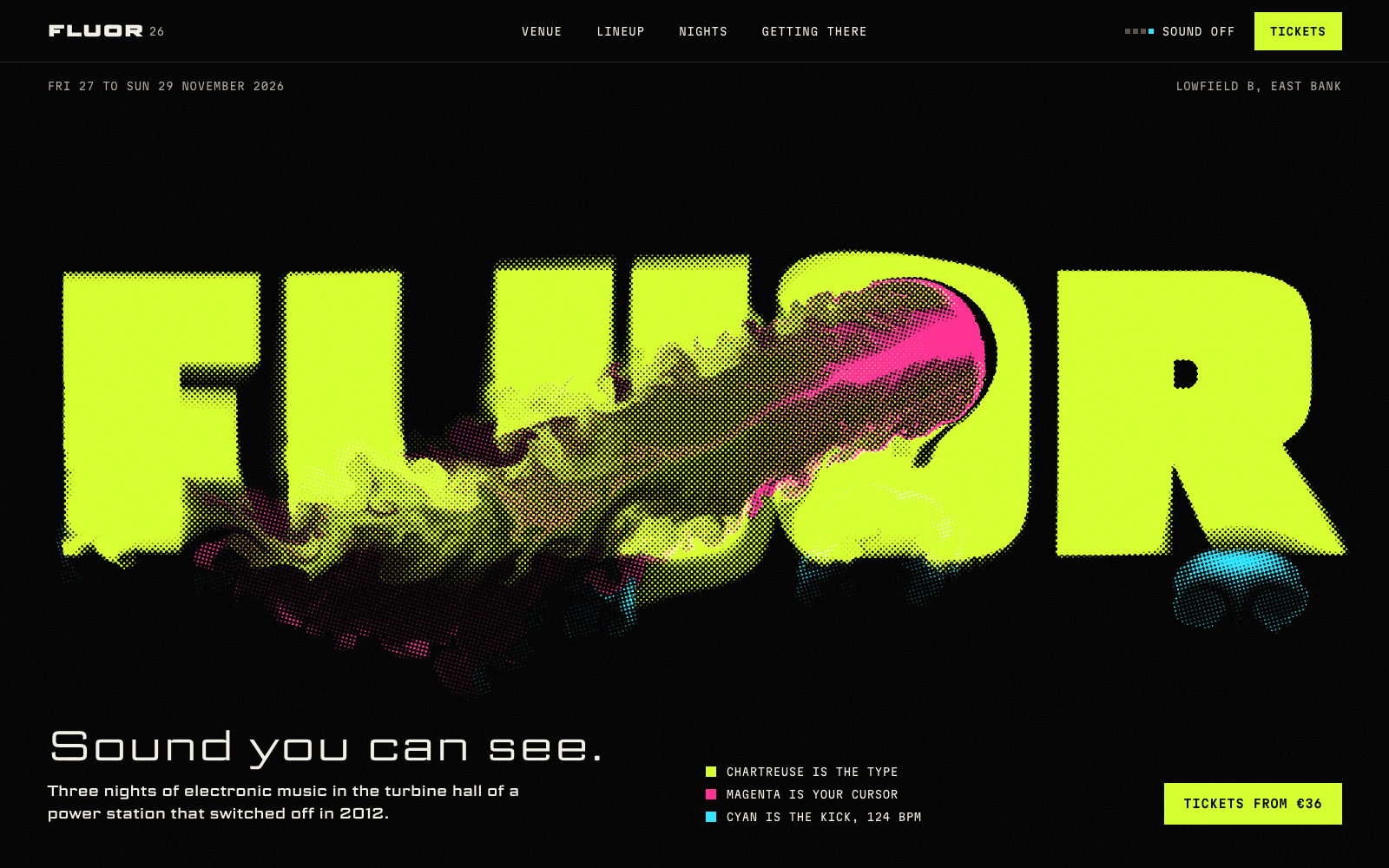
Three nights of electronic music in a disused power station, printed in ink you can stir.
A concept site for a fictional three-night electronic music festival in a disused power station. The type is live fluorescent ink: your cursor stirs it and the kick drum pushes it at 124 BPM.
FLUOR 26 is the website of a three-night electronic music festival in the turbine hall of a power station that switched off in 2012. The page has to sell single-night and three-night tickets and answer the practical questions: when, who, how much, how to get there. Before it says any of that, it makes the festival's idea felt in the first second. The idea is sound you can see.
It is a concept site, made by the Laarpi team with Laarpi's library and process. The festival, the venue, the lineup and the tram line are invented, and the footer says so. The halls in the background are real photographs.
In the story, a forty-metre tank of fluorescent ink runs along the north wall of the Turbine Hall under UV light, with the sub-bass bolted to its frame. Every kick moves the ink, so you see the sound a moment before you feel it. The page is a model of that tank. The type is printed in the ink, your cursor stirs it, and the kick drum pushes it at 124 BPM.
The audience was set first: club-goers and electronic music fans, roughly 20 to 45, who travel for a lineup and care how a night looks as much as how it sounds. The voice was specific, dry and nocturnal. The brief also listed what to leave out: lasers, crowds with their hands in the air, stock photos of DJs, purple-to-blue gradients, hype words and exclamation marks, invented sponsors, and crude 3D stand-ins for real machinery.
The colour works like a three-plate risograph print where every ink has one job. Chartreuse is the type. Magenta is your hand. Cyan is the kick drum and the photographed halls. Warm white is only for reading. There are no CSS gradients anywhere: colour arrives only as ink, in halftone dots with a hair of misregistration, so overlaps print as overprint.
The ink is a stable-fluids simulation, the method Jos Stam published at SIGGRAPH 1999, running on the graphics card with vorticity confinement to keep the swirls alive. It holds three inks at once. The page's real text is drawn pixel-exact into the fluid, one font instance per width setting, and wherever the liquid has settled the type plate is pulled back into place, which is why the letters always re-form. A final print pass turns the three inks into halftone screens, each at its own angle, like a real riso plate.
The venue chapter reuses the same floor. It tips into a perspective view inside three photographed power-plant halls, CC0 HDRIs from Poly Haven tone-mapped to luminance and printed as a single cyan plate, and the wet floor reflects the windows.
The type is one variable family pushed to both ends. Science Gothic runs from 50% to 200% width: industrial signage at one end, a synth front panel at the other. The wordmark solves its own width so it always fills the frame, the lineup maps width to tempo, and the footer repeats FLUOR at the opposite end of the axis. Martian Mono carries every number, time and label. Text blocks knock the ink out behind them, so copy always sits on black. Choosing fonts that aren't Inter covers how to pick a face that can carry an idea like this. If the three-plate look suits your own project, the Riso Zine style is the closest direction in Laarpi's library.
The interactive website examples show where FLUOR sits among our other concept sites. For a real festival, gig or club night, the event website guide covers lineups, timetables, tickets and travel, and the music artist website guide covers the artist's side.
Measured on 6 October 2026, cold, with an empty cache, on our phone profile: slow 4G (1.6 Mbps down, 150 ms round trip), CPU slowed four times, a 390 × 844 screen.
| What | Measured |
|---|---|
| First paint, with the loader | 1.6 s |
| First frame with the ink drawn | 4.6 s |
| Transferred before that frame | 332 KB, 13 requests |
| Transferred in all | 911 KB, 16 requests, one origin |
The three hall photographs, about 580 KB together, wait until the first frame is on screen, so they never hold up the ink. The loader, "Filling the tank", draws the outline of the tank where the wordmark will be printed and fills it with chartreuse as the real progress arrives, its surface lifting one swell to a bar at 124 BPM. At 100% it drains from the bottom until only the type is left standing in ink.
Before this pass, the same page took 6.5 seconds on the same profile and pulled 1,257 KB from four origins. The libraries are now bundled to just what the site uses and served, with the fonts, from the site's own origin. Rendering resolution is capped (2× on desktop, 1.5× on phones), quality adapts to the device, and rendering pauses in hidden tabs. The phone profile slows the CPU but not the graphics chip, so real phones can take longer on the simulation. Fast websites with 3D explains the techniques.
With reduced motion on, the page becomes a still print: the same three plates, one baked stroke through the wordmark, and the venue as a plain section with rendered stills of each hall. Smooth scrolling is off. Nothing flashes, and the kick never goes above 172 BPM. The sound stays off until you turn it on. Navigation, the sound toggle and every ticket are ordinary buttons. Stirring the ink and melting the lineup are pointer and touch effects; every name, tempo, night and room is also written as plain text. Accessible motion covers these decisions for your own site.
A concept site made by the Laarpi team with Laarpi's library and process. It was not produced end to end by SI, Laarpi's website agent. Sites SI builds on its own carry a "Built by SI" label with their build time and cost.
Third-party pieces, all free for commercial use:
| Piece | By | Licence |
|---|---|---|
| Peppermint Powerplant 2 (Turbine Hall) | Andreas Mischok, Poly Haven | CC0 |
| Peppermint Powerplant (Boiler House) | Andreas Mischok, Poly Haven | CC0 |
| Boiler Room (Pump House) | Oliksiy Yakovlyev, Poly Haven | CC0 |
| Science Gothic | Thomas Phinney, Vassil Kateliev, Brandon Buerkle | SIL OFL 1.1 |
| Martian Mono | Roman Shamin, Evil Martians | SIL OFL 1.1 |
| three.js 0.186.1 | three.js authors | MIT |
| GSAP 3.15.0 | GreenSock | Standard No Charge License |
| Lenis 1.3.26 | darkroom.engineering | MIT |
The fluid follows Jos Stam's "Stable Fluids" (SIGGRAPH 1999), with the general pass layout of Pavel Dobryakov's MIT-licensed WebGL fluid simulation as a reference; no code was copied. The type-in-ink restore, the scroll attachment, the halftone print, the loader and the sound are original to this site.
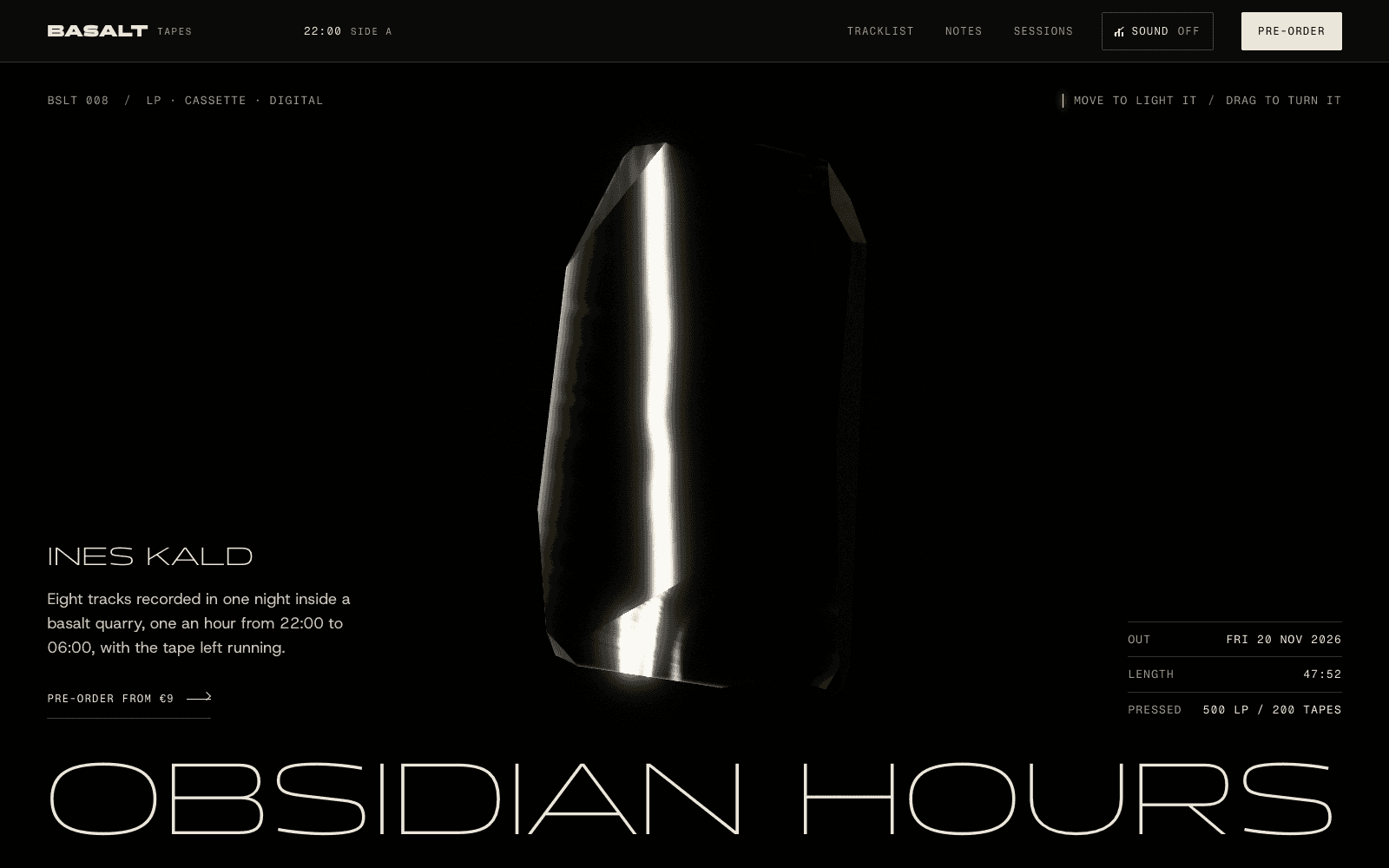
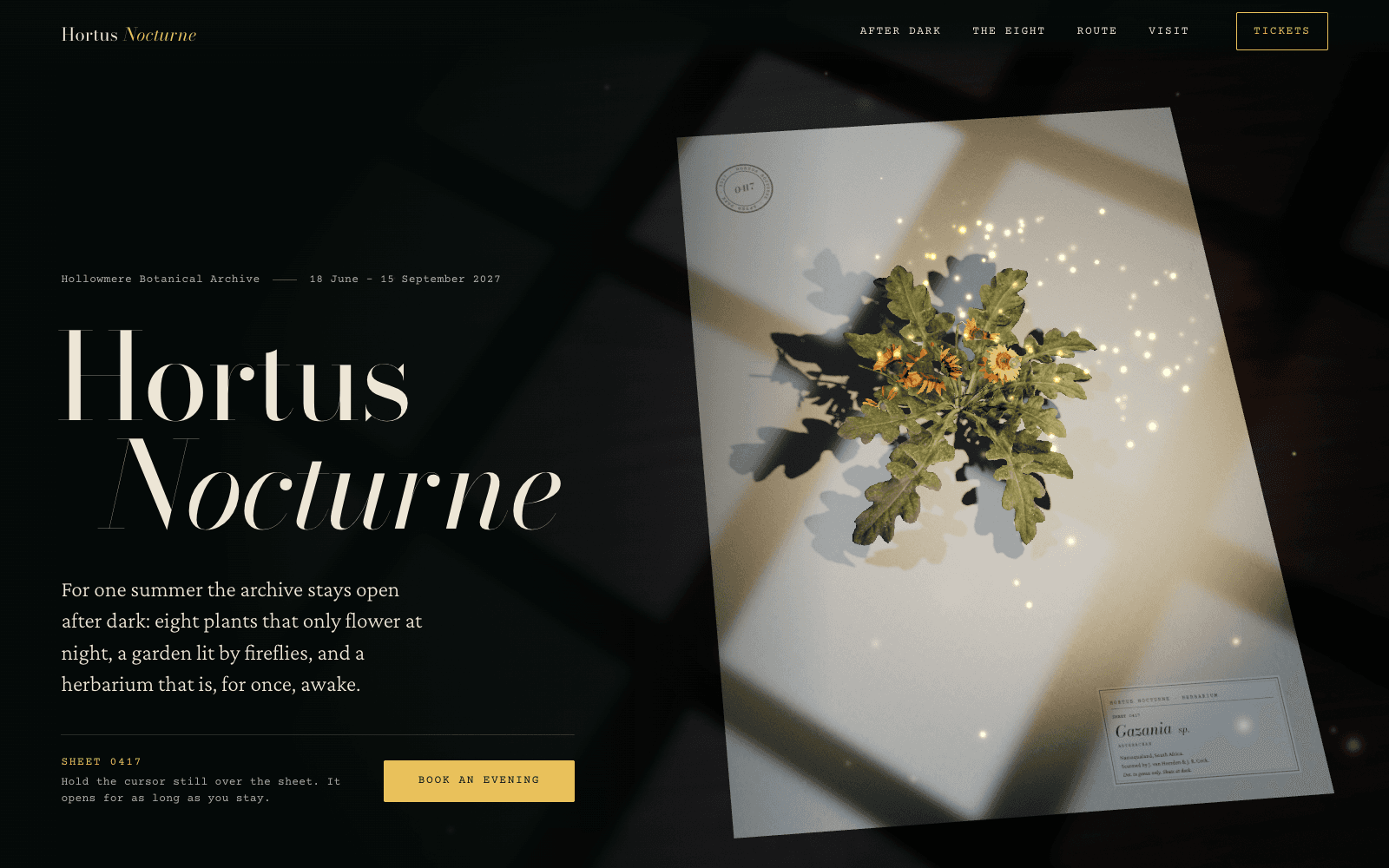
For more music on the web, see BASALT Tapes, a record you light and break into eight tracks, and Hortus Nocturne, another night out, this time in a garden. To start your own event site from this one, remix it.
No. FLUOR, the Lowfield B power station, the lineup and the tram line are fictional, and the footer says so. The three halls in the background are real photographs of power-plant interiors, used under CC0 as stand-ins. It is a concept site the Laarpi team made to show what a festival site can be.
No. The four ticket buttons are wired for a Polar checkout, but no account is connected to this concept, so they are marked unavailable, nothing is sold, and pressing one says so. On your own site the same buttons open a real checkout once you connect your Polar account.
No. It was made by the Laarpi team with Laarpi's library and process, with people steering every step. Sites that SI builds end to end are labelled "Built by SI" and show their build time and cost.
No. It is a fluid simulation running live in your browser, and the type is drawn into it, so every visit moves differently. Nothing is pre-rendered, and the music behind the Sound button is generated in the browser too.
No. The kick pulses at the act's tempo, never faster than 172 BPM, which is under three pulses a second, and nothing flashes. With reduced motion on, the page is a still print.
Yes. Remix copies the site's code and plan into a project of your own, and you tell the agent what to change. Bring your own lineup, venue, dates and tickets; a remix gives you the design and code, not the fictional festival.
One fire on an Oregon bluff, sunset to moonrise. Tonight's menu is written in its smoke.
Laarpi Studio
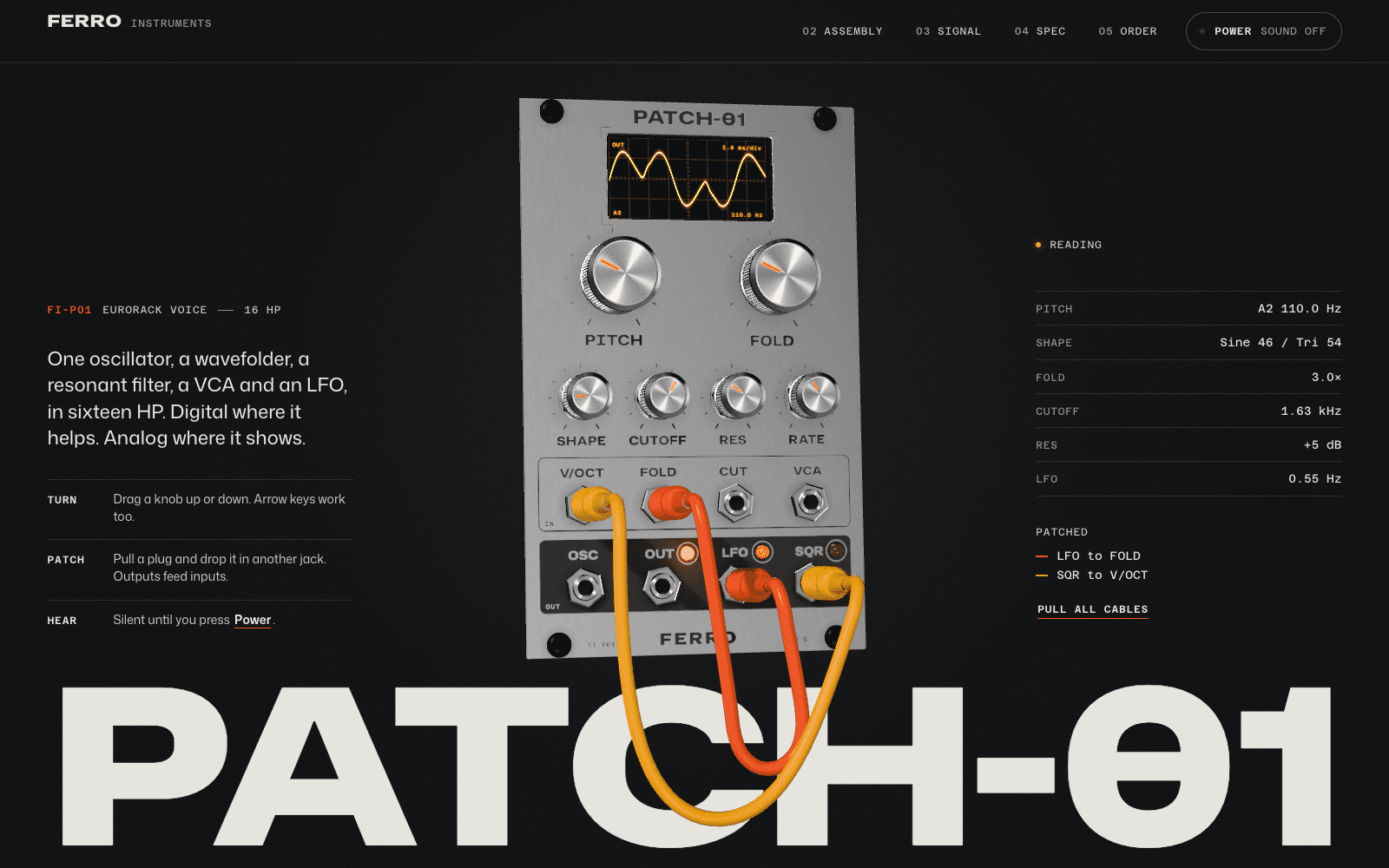
A Eurorack voice you can play in the page: turn it, patch it, take it apart, hear it.
Laarpi Studio
A hand-wound calibre you can wind, take apart under a loupe and watch start again.
Laarpi Studio
A pressed gazania that stands up and blooms only while you hold the cursor still.
Laarpi Studio
Remix this site, or describe a new one. It asks what matters, then designs and builds it from scratch.